【引言】
不少养殖场计划上烘干设备,面对市面上五花八门的烘干机型,很容易陷入选型困境。很多养殖户只盯着报价高低,轻信一机多用的宣传,设备买回来投产之后,频繁堵料卡机、能耗居高不下、故障频发,环评验收无法通过,钱投入进去,粪污问题依旧没有得到解决。
鸡粪属于高含水、高粘性特殊物料,并不是所有烘干设备都可以适配。选购烘干设备,不能单一比价,要结合物料属性、现场生产工况、环保核查要求综合评估。今天结合大量一线项目实测,拆解市面主流机型的优缺点,帮广大养殖户避开选型陷阱,挑选真正适配鸡场工况的烘干设备。
Many breeding farms are planning to install drying equipment. Faced with a wide variety of dryer models on the market, they can easily get stuck in equipment‑selection dilemmas. Many farmers only focus on quoted prices and fall for advertisements claiming “one machine for all purposes”. After purchasing and commissioning the equipment, they encounter frequent material blockages and jams, persistently high energy consumption, constant breakdowns, and failure to pass environmental‑impact assessment checks. Heavy investment yields no real solution to manure‑treatment problems.
Chicken manure is a special material with high moisture and high viscosity, and not all drying equipment is compatible with it. When selecting dryers, price comparison alone is insufficient. Comprehensive evaluation should take material properties, on‑site production conditions and environmental‑inspection requirements into account. Drawing on abundant field‑test data from front‑line projects, this article analyzes the pros and cons of mainstream models available, helping farmers steer clear of selection pitfalls and pick dryers truly suited for chicken‑farm operating conditions.
一、市面常见烘干设备通病,不少养殖场已经踩坑
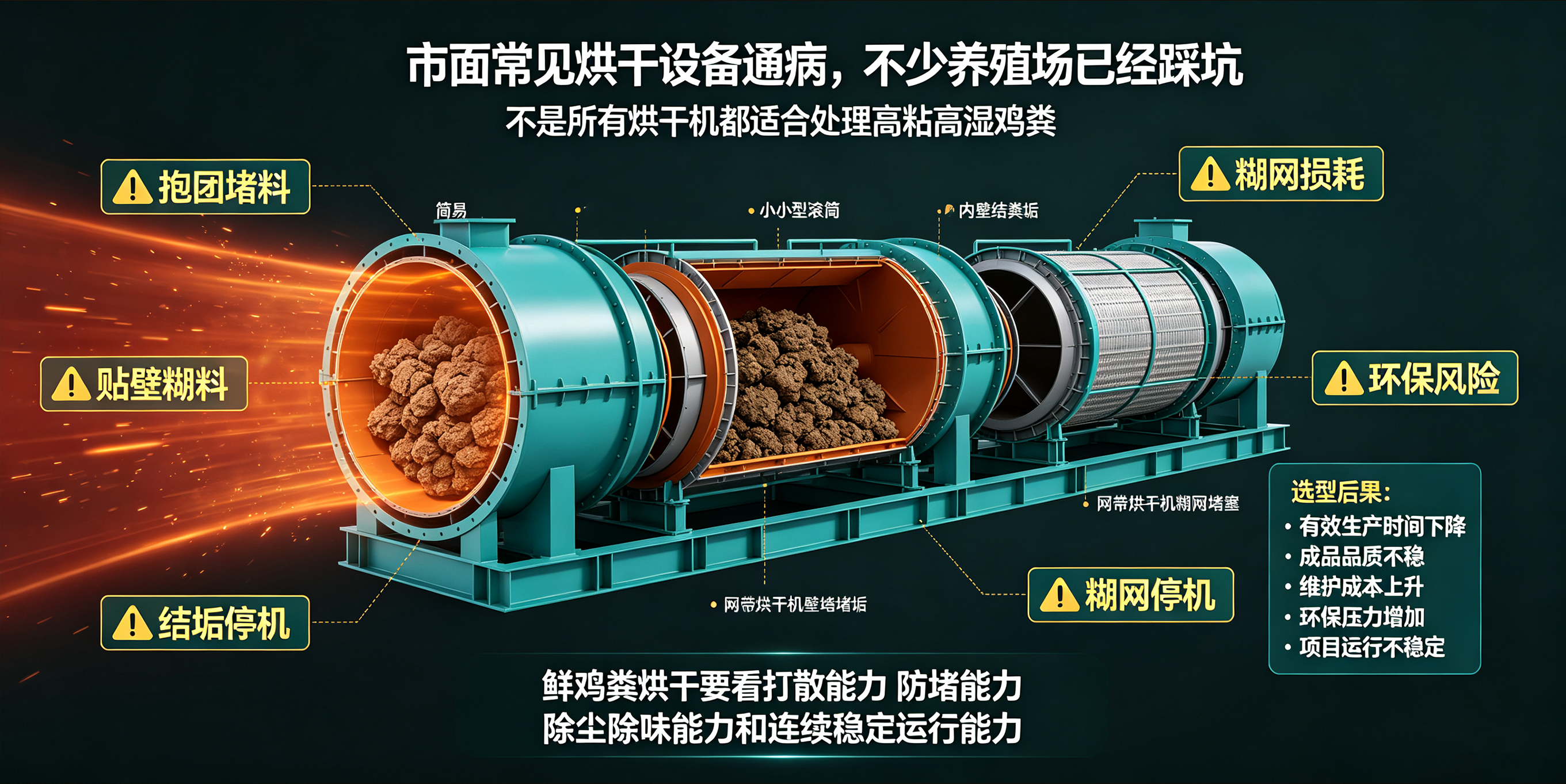
简易烘干机、小型滚筒、网带机在处理鸡粪这类高粘物料时,本身存在先天短板,也是很多烘干项目投产失败的核心原因:
❌简易烘干机:结构简化缺失打散机构,高湿鸡粪进入设备直接抱团,堵料现象频发;缺少成套除尘除味配套,粉尘异味直排,环保检查直接不合格,只能做短期应急使用,无法实现长期稳定连续生产。
❌小型滚筒烘干机:更加适配泥沙、秸秆这类低粘度物料。鲜鸡粪粘性强,湿物料贴壁糊料,筒内壁结粪垢严重,需要频繁停机人工清理,有效生产时间大幅压缩,成品夹生、干湿不均问题突出。
❌网带烘干机:占地面积大,设备整体造价高;湿鸡粪极易糊网、堵塞网孔,网带损耗快,更换成本高昂;实际处理产能有限,不适合规模化鸡场大批量粪污持续处置。
以上机型处理普通物料尚可,面对 70-80% 含水率鲜鸡粪,故障问题层出不穷,很难做到常态化稳定运行。
I. Common Defects of Commercial Drying Equipment — Pitfalls Many Farms Have Fallen Into
Simple dryers, small rotary drums and mesh‑belt dryers have inherent weaknesses when handling highly‑viscous materials such as chicken manure, which are core causes of failed drying projects: ❌ Simple dryers: Simplified structures lack material‑breaking mechanisms. High‑moisture chicken manure clumps immediately upon entering the unit, triggering frequent blockages. Without complete dust‑removal and de‑odorization accessories, dust and odors are discharged directly, resulting in automatic environmental‑inspection failures. They can only serve short‑term emergency use and cannot sustain long‑term continuous stable production.
❌ Small rotary‑dryers: Better suited for low‑viscosity materials like sediment and crop straw. Fresh chicken manure is highly viscous; wet material sticks to inner cylinder walls and forms thick manure scale. Frequent shutdowns for manual cleaning are required, greatly cutting effective production hours. Finished products suffer severe uneven drying with partially unprocessed material.
❌ Mesh‑belt dryers: Large footprint and high overall capital cost. Wet chicken manure easily clogs and smears the mesh belt, causing fast belt wear and steep replacement expenses. Actual processing capacity is limited, making them unsuitable for continuous large‑volume manure disposal in large‑scale chicken farms.
While these models perform adequately for ordinary materials, they suffer endless malfunctions when processing fresh chicken manure of 70‑80% moisture content and can hardly maintain regular stable operation.
二、低价设备隐形坑:看得见的低价,看不见的高额后期成本
行业价格战环境下,不少低价设备依靠删减配置压低报价,前期采购成本看着低,后期各类隐性成本持续消耗养殖场利润,很多养殖户投产之后才幡然醒悟。
偷工减料缩减用料:筒体板材减薄,打散、扬料核心部件简化,耐磨防腐性能差,零部件磨损速度快,后期配件更换频次高。
热效率大打折扣:筒体保温结构缺失,热量大量散失,燃料消耗居高不下,吨料烘干能耗成本显著抬高。
环保配置直接阉割:仅售卖主机,除尘、除臭、废气处理配套不全,投产后粉尘异味超标,无法完成环评验收,也不能申报粪污资源化改造补贴。
售后保障缺失:小厂家没有成熟技术服务团队,设备故障响应慢,维修周期长;一旦设备停机,粪污处理直接停滞,场区粪污堆积,极易触发环保整改处罚。
采购设备不能只对比裸机报价,能耗、运维配件损耗、环保合规都要纳入整体核算,购机便宜不等于整体使用成本低。
II. Hidden Pitfalls of Low‑cost Equipment: Visible Low Price, Invisible Heavy Long‑term Expenses
Amid fierce industry price competition, many low‑cost units cut quotations by stripping functional configurations. Though upfront purchase costs appear low, various hidden expenses keep eroding farm profits, a reality many farmers realize only after commissioning.
Cut‑corner material usage: Thinner cylinder plates and simplified core components for breaking and lifting materials lead to poor wear and corrosion resistance. Parts wear rapidly and spare‑part replacement becomes frequent.
Deteriorated thermal efficiency: Missing cylinder insulation causes massive heat loss and excessive fuel consumption, substantially raising energy costs per ton of processed material.
Removed environmental‑protection assemblies: Only main units are sold, lacking supporting dust‑removal, de‑odorization and waste‑gas treatment systems. Post‑commissioning dust and odor exceed regulatory limits, blocking environmental‑assessment approval and disqualifying farms from manure‑resource‑reutilization renovation subsidies.
Absent after‑sales guarantees: Small manufacturers lack mature technical‑service teams, leading to slow fault responses and lengthy repair cycles. Equipment shutdown halts manure treatment entirely, causing on‑site manure accumulation and high risks of environmental‑penalty rectification orders.
When sourcing equipment, do not merely compare bare‑unit quotations. Energy consumption, spare‑part wear‑and‑tear for maintenance and environmental‑protection compliance must be included in total‑cost calculations. Low purchase price does not equal low overall operating cost.
三、主流机型全方位实测对比:粘堵率、日产能、耗电量、人工需求、环保达标等级
结合大量落地项目现场运行数据,从粘堵率、日处理产能、耗电量、人工需求、环保达标等级多维度横向对比,看清各机型真实适配边界:
简易烘干机 粘堵率:高,频繁堵料停机;日产能:低;耗电量:偏高;人工需求:23 人;环保达标等级:无完整配套,很难达标;适用场景:临时小批量应急处理,不适合规模化鸡场长期使用。
小型滚筒烘干机 粘堵率:较高,筒壁结粪垢,需要定期拆机清理;日产能:中等;耗电量:高;人工需求:24 人;环保达标等级:需要额外配齐整套除尘除臭;适用场景:低粘度物料,不推荐直接处理高粘鲜鸡粪。
网带烘干机 粘堵率:中等,容易糊网;日产能:中等;耗电量:高;人工需求:12 人;环保达标等级:全套配齐可以达标;适用场景:低湿度松散物料,占地面积大,投资成本高。
金万泓卧式闪蒸烘干机 粘堵率:低,动态悬浮打散,物料不贴壁;日产能:机型跨度大,大小产能全覆盖;耗电量:热效率高,综合能耗更低;人工需求:1 人值守,自动化程度高;环保达标等级:整机配套密闭负压除尘除臭,直接满足环评验收标准;适用场景:70-80% 高含水鲜鸡粪,适配大中小各类规模化养殖场连续化生产。
III. Comprehensive Field‑test Comparison of Mainstream Models: Blockage Rate, Daily Capacity, Power Consumption, Labor Requirement, Environmental‑compliance Level
Based on operating data from numerous completed projects, multi‑dimensional horizontal comparison across blockage rate, daily processing capacity, power draw, labor input and environmental‑compliance level clarifies the real application boundaries of each model:
Simple dryer Blockage rate: High, frequent blockages force shutdowns; Daily capacity: Low; Power consumption: Relatively high; Labor requirement: 2‑3 workers; Environmental‑compliance level: No complete supporting assemblies, compliance hard to achieve; Application: Temporary small‑batch emergency disposal, not for long‑term large‑scale chicken‑farm operation.
Small rotary dryer Blockage rate: Relatively high, manure scale builds on cylinder walls requiring periodic disassembly for cleaning; Daily capacity: Medium; Power consumption: High; Labor requirement: 2‑4 workers; Environmental‑compliance level: Extra full dust‑removal & de‑odorization assemblies mandatory; Application: Low‑viscosity materials; not recommended for direct processing of high‑viscosity fresh chicken manure.
Mesh‑belt dryer Blockage rate: Medium, mesh‑smearing occurs easily; Daily capacity: Medium; Power consumption: High; Labor requirement: 1‑2 workers; Environmental‑compliance level: Achievable with full supporting assemblies; Application: Low‑moisture loose materials; large footprint and high investment.
Jinwanhong Horizontal Flash Dryer Blockage rate: Low. Dynamic suspension‑type material breaking prevents wall adhesion; Daily capacity: Wide‑range models covering both small and large throughput demands; Power consumption: High thermal efficiency for lower comprehensive energy consumption; Labor requirement: 1 attendant, high automation; Environmental‑compliance level: Factory‑fitted sealed negative‑pressure dust‑removal and de‑odorization, directly meeting environmental‑assessment acceptance standards; Application: 70‑80% high‑moisture fresh chicken manure, supporting continuous production for chicken farms of all scales.
四、卧式闪蒸专属优势:针对性适配高粘鸡粪,免清理少故障、可连续生产、合规性拉满
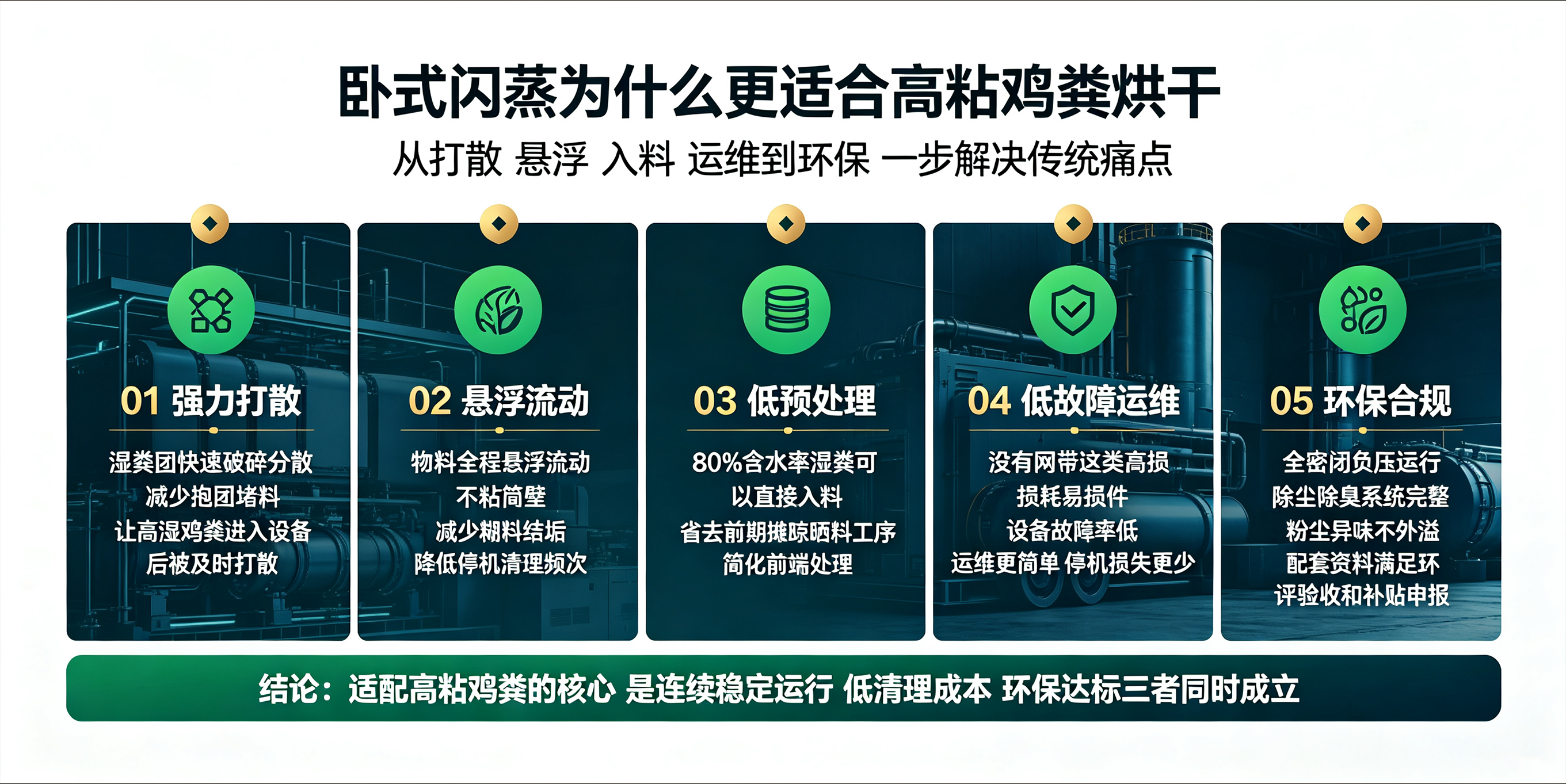
区别于市面上通用烘干设备,卧式闪蒸从工艺层面定向针对鸡粪高含水、高粘性物料研发,解决传统烘干设备固有痛点。
✅强力打散 + 动态悬浮工艺,湿粪团快速破碎分散,物料全程悬浮流动,不粘筒壁,大幅减少停机清理频次,保障设备 24 小时连续生产。
✅鲜鸡粪无需复杂预处理,80% 含水率湿粪可以直接入料,省去前期摊晾晒料工序。
✅设备故障率低,运维简单,没有网带这类高损耗易损件,降低停机带来的生产损失。
✅成套环保配置一步到位,全密闭负压运行,除尘除臭系统配套完整,粉尘异味不外溢,轻松应对环保巡查;全套资质资料齐全,满足环评验收、项目补贴申报条件。
IV. Exclusive Advantages of Horizontal Flash Dryers: Purpose‑built for High‑viscosity Chicken Manure, Minimal Cleaning, Few Failures, Continuous Production and Full Compliance
Different from general‑purpose dryers on the market, horizontal flash dryers are technologically developed specifically for high‑moisture, high‑viscosity chicken manure, resolving inherent drawbacks of traditional drying equipment. ✅ Powerful breaking + dynamic‑suspension process: Wet manure clumps are rapidly shattered and dispersed. Materials keep suspended in flow without sticking to cylinder walls. Cleaning shutdowns drop sharply, enabling 24‑hour non‑stop stable equipment operation. ✅ Fresh chicken manure requires no complex pre‑treatment. Manure with 80% moisture can feed directly into the unit, eliminating pre‑drying and spreading procedures. ✅ Low failure rate and easy maintenance. No high‑wear consumables such as mesh belts, minimizing production losses caused by downtime. ✅ Complete one‑step environmental‑protection configurations. Fully‑sealed negative‑pressure operation with integrated dust‑removal and de‑odorization systems prevents dust and odor leakage and easily passes environmental inspections. Complete qualification documents satisfy environmental‑assessment acceptance and project‑subsidy application requirements.
五、不同养殖规模适配机型推荐,杜绝大材小用、小机带大活的浪费问题
选型不是设备越大越好,匹配自身存栏规模、日产粪污量才是最优方案,避免设备闲置,或是小设备超负荷运转产能不足。
小型鸡场(80-100万羽):选用小型卧式闪蒸机型,满足日产粪污处理需求,兼顾预算,够用不浪费。
中小型规模化鸡场(100-200万羽):标准卧式闪蒸成套产线,实现粪污日产日清,预留富余产能,应对雨季、冬季存量粪污消化。
大型鸡场、粪污集中处理产业园(200万羽以上):大产能卧式闪蒸成套生产线,可拓展粪污代加工业务,对接有机肥外销,适配全天候 24 小时不间断生产。
不盲目追求超大设备,也不要小设备硬扛高负荷生产,预留合理产能余量,兼顾采购预算与长期运行稳定性。
V. Model Recommendations for Different Farm Scales — Avoid Waste from Over‑sized Units or Overloaded Small Equipment
Equipment selection does not mean “the bigger the better”. Optimal solutions match actual livestock inventory and daily manure output, preventing equipment idleness or insufficient throughput from overburdened small machines.
Small‑scale chicken farms (800 000‑1 000 000 birds): Compact horizontal flash dryer models. Satisfy daily manure‑processing needs within budget, adequate without waste.
Medium‑to‑large‑scale chicken farms (1 000 000‑2 000 000 birds): Standard complete horizontal flash‑dryer production lines. Realize zero‑accumulation daily manure disposal, with surplus capacity to digest stockpiled manure in rainy and winter seasons.
Large‑scale chicken farms & centralized manure‑treatment industrial parks (over 2 000 000 birds): High‑throughput complete horizontal flash‑dryer lines. Support third‑party manure‑processing outsourcing and organic‑fertilizer sales, adapting to round‑the‑clock 24‑hour non‑stop production.
Avoid blindly purchasing oversized units or forcing small machines to handle heavy loads. Reserve reasonable capacity margin, balancing procurement budget and long‑term operational stability.
六、新手养殖户选型误区、预算分配、落地注意事项详解
❌误区一:只看主机价格,忽略上料输送、除尘除臭等配套。很多养殖户只采购主机,环保配套缺失,设备建好之后无法验收投产。
❌误区二:迷信一机通吃全部物料。每一类设备都有自己适配边界,鸡粪粘性强,不能直接照搬处理秸秆、矿石的通用烘干设备。
❌误区三:只看铭牌理论产能,忽略高含水工况的实际有效产能。理论产能不等于鲜鸡粪实际处理能力,一定要参考同类型场区真实落地案例。
预算分配参考:设备采购预算,需要包含主机、输送上料、除尘除臭、热源系统、安装调试,不能只算裸机价格;同时预留后期运维、备用配件预算。
落地注意事项:优先实地考察厂家真实落地项目,查看同类型鸡场现场运行实况;确认厂家可以提供完整资质、检测报告,满足环评和补贴申报;确认售后响应时效,保障故障能够快速处置。
VI. Detailed Explanation of Selection Misconceptions, Budget Allocation and Implementation Notes for New Farmers
❌ Misconception 1: Focus solely on main‑unit price and ignore supporting systems such as feeding‑conveying, dust‑removal and de‑odorization. Many farmers purchase only main machines without environmental‑protection accessories, leaving completed installations unable to pass acceptance and go into service.
❌ Misconception 2: Believe one machine can handle all material types. Every piece of equipment has its applicable boundaries. Chicken manure features high viscosity; general‑purpose dryers designed for straw or ore cannot be copied directly.
❌ Misconception 3: Rely only on nameplate theoretical capacity and overlook real effective throughput under high‑moisture working conditions. Theoretical capacity does not equal actual fresh‑chicken‑manure processing capability. Always reference real‑world operating cases from similar farms.
Budget reference: Procurement budgets shall cover main unit, feeding‑conveying, dust‑removal & de‑odorization, heat‑source systems, installation and commissioning, rather than bare‑machine price alone. Reserve funds for later‑stage maintenance and spare parts.
Implementation tips: Prioritize on‑site visits to manufacturers’ finished projects and inspect real‑time running status at comparable chicken farms. Confirm suppliers provide complete qualification documents and test reports for environmental assessment and subsidy applications. Verify after‑sales response timeliness to guarantee rapid fault resolution.
七、多场地不同机型落地实景对比,直观体现设备差距
同样是鸡粪烘干项目,设备选型不同,现场运行工况差距十分明显。
选用简易设备、普通滚筒设备的部分场区:筒壁附着大量粪垢,厂区周边异味突出,工人需要频繁进入设备内部清理粘壁物料,设备开开停停,生产断断续续,烘干成品干湿差异大。
落地金万泓卧式闪蒸烘干机的养殖场区:整套产线密闭运行,设备内部不易积料,不用频繁拆机清理;场区无明显异味,设备可以长时间连续运转,出料含水率稳定可控,场区粪污做到日产日清,顺利通过环保核查与项目验收。
选型的对错,直接决定后期厂区运维压力、环保风险以及粪污资源化带来的实际收益。
VII. Real‑site Comparison of Different Models — Visual Demonstration of Equipment Performance Gaps
Even for identical chicken‑manure‑drying projects, different equipment choices create huge on‑site operational differences.
Farms using simple dryers or ordinary rotary dryers: Heavy manure scale adheres to cylinder walls. Strong odors spread around plant premises. Workers must frequently enter equipment interiors to clear stuck material. Units start‑stop intermittently with discontinuous output, and finished dried material shows wide moisture inconsistency.
Farms deploying Jinwanhong Horizontal Flash Dryers: Entire production lines run sealed. Material buildup inside equipment is minimal, eliminating frequent disassembly for cleaning. No noticeable on‑site odors. Equipment sustains long‑hour continuous operation with stable, controllable output moisture. Daily manure is fully processed, and projects smoothly pass environmental‑inspection and official acceptance.
Right or wrong equipment selection directly determines long‑term farm maintenance pressure, environmental‑protection risks and real profits from manure resource‑utilization.
写在最后
烘干设备属于养殖场固定资产,是长期使用的大型装备,千万不能单纯把价格作为唯一选购标准。
能够适配鸡粪高粘物料特性、运行稳定、运维成本可控、顺利通过环评,才是一台好烘干设备的评判标准。避开低价坑机,选对适配机型,才能真正解决粪污处置难题,实现环保达标和资源化增收双重目标。
如果你不清楚自家场区适配多大产能设备,可以提供存栏规模、场地条件,获取金万泓机械一对一选型建议。
Drying equipment represents fixed‑asset large‑scale farm infrastructure for long‑term service. Price must never be the sole purchasing criterion.
A high‑quality dryer should suit high‑viscosity chicken‑manure properties, operate reliably, keep maintenance costs manageable and pass environmental‑impact assessment smoothly. Steer clear of cheap defective units and select properly‑matched models to truly resolve manure‑disposal challenges and achieve dual goals of environmental‑protection compliance and resource‑reutilization revenue growth.
If you are unsure which capacity suits your farm, provide your livestock inventory and site conditions for one‑on‑one equipment‑selection advice from Jinwanhong Machinery.