【引言】
很多养鸡场在挑选卧式闪蒸鸡粪烘干机的时候,第一关注点就是设备标牌标注的时产,很容易直接按照标牌产能下单。等到设备进场投产才发现:标牌产量是理想工况下的干料产能,不是高含水鲜粪处理量;再叠加实际生产班次、物料波动,要么设备选大了,购机、能耗投入白白浪费;要么产能偏小,粪污持续积压,环保压力居高不下。选型核心不是挑参数好看的机型,而是以存栏量、日产鲜粪总量、每日有效生产时长、物料特性、后端利用方向为基准做测算,下面把整套选型逻辑、测算方式和场景方案完整拆解。
When chicken farms select a horizontal flash chicken manure dryer, they usually first look at the hourly output marked on the equipment nameplate and tend to place orders directly based on this rated capacity. Only after delivery and commissioning do they find that the figure on the nameplate refers to dry material output under ideal working conditions, not the processing capacity for high-moisture fresh manure. Coupled with variable production shifts and unstable material properties, farms either oversize the unit and waste capital and energy costs, or buy under-capacity equipment that cannot keep up with manure output, resulting in persistent stockpiling and heavy environmental compliance pressure.
Equipment selection should not focus on attractive nominal parameters. Instead, capacity calculation must be based on livestock inventory, daily fresh manure yield, effective daily operating hours, material characteristics and downstream utilisation routes. Below is a full breakdown of the selection logic, calculation method and application scenarios.
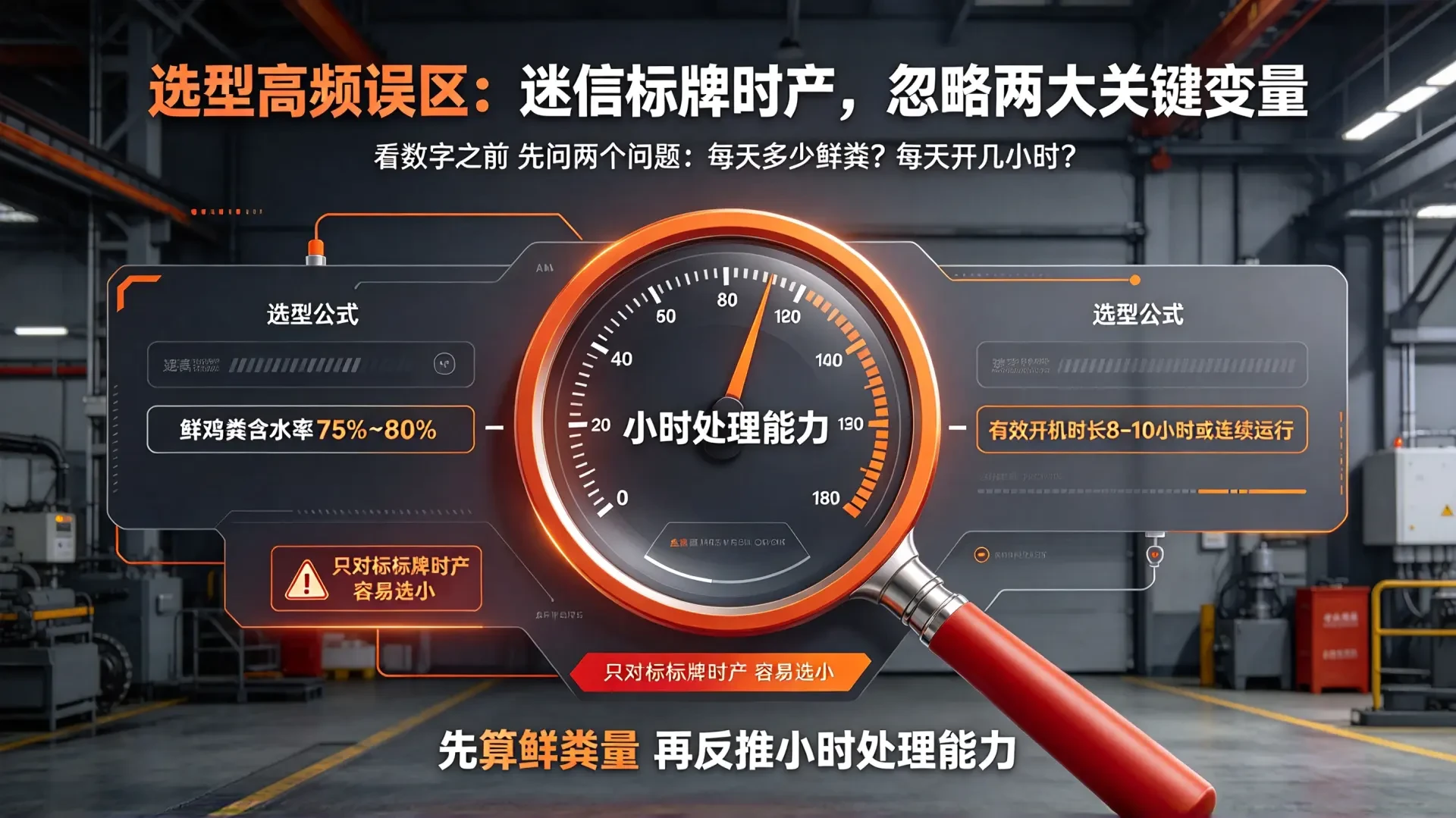
一、选型高频误区:迷信标牌时产,忽略两大关键变量
1.混淆鲜粪产能和干料产能 设备铭牌标注的时产,很多是出料干料产量;而养殖场需要消化的是含水率 75%~80% 的高含水鲜鸡粪,同等数字下,鲜粪处理量要远高于干料,直接对标标牌很容易选小。
2.没有核算有效开机时长 不是 24 小时满负荷连续生产。部分中小鸡场只白天生产 8–10 小时,大型基地才会两班倒、三班连续运行。日产粪量固定,每日开机时间越短,需要的单机时产就要越高。
避坑提醒:选型第一步,先算清楚【每天一共产生多少鲜鸡粪】,再反推需要的小时处理能力,而不是直接看机型宣传参数。
I. Common Selection Pitfall: Over-reliance on Nameplate Hourly Output While Ignoring Two Critical Variables
Confusing fresh manure capacity and dry material capacity Many nameplate hourly output values indicate finished dry material throughput. What farms need to process, however, is high-moisture fresh chicken manure at 75%–80% moisture content. For the same numerical value, the required fresh manure handling capacity is far higher, so selecting purely against the nameplate rating often leads to undersizing.
Failure to calculate effective operating hours Continuous 24-hour full-load operation is not always feasible. Most small and medium chicken farms only run 8–10 hours during daytime, while large bases adopt two-shift or three-shift continuous operation. Given a fixed daily manure output, shorter daily operating hours demand higher hourly processing capacity of the dryer.
Tip to avoid mistakes: The first step of selection is to calculate the total daily fresh chicken manure output, then back-calculate the required hourly throughput, rather than simply referring to promotional specifications.
二、基础测算参考:蛋鸡、肉鸡日产鲜粪基准参考
说明:为行业通用参考值,受饲料配方、饮水、清粪工艺影响有浮动,仅作为选型测算基准
✅ 蛋鸡(产蛋鸡):粪便含钙石粉,比重偏大、粘性强
✅ 肉鸡(快大型白羽肉鸡)周期短、粪中粗纤维、鸡毛占比更高
举例参考:80 万羽蛋鸡基地:日产鲜粪大约80-90吨;100万羽蛋鸡基地:日产鲜粪大约100吨;200万羽肉鸡场:日产鲜粪大约200吨。
拿到存栏数量之后,先算出每日总粪量,再结合每天计划开机时长,计算所需小时处理量:
II. Basic Reference for Calculation: Benchmark Daily Fresh Manure Output for Layers and Broilers
Note: These are general industry references and subject to fluctuation depending on feed formula, water intake and manure cleaning methods. They serve only as the baseline for capacity calculation.
✅ Laying hens: Manure contains limestone powder, featuring higher specific gravity and strong adhesion.
✅ Fast-growing white-feathered broilers: Shorter breeding cycle; manure contains more crude fibre and chicken feathers.
Examples for reference:
800,000-layer farm: approx. 80–90 tonnes of fresh manure per day
1,000,000-layer farm: approx. 100 tonnes of fresh manure per day
2,000,000-broiler farm: approx. 200 tonnes of fresh manure per day
After confirming the inventory size, calculate the total daily manure volume, then work out the required hourly processing capacity according to planned daily operating hours.
三、两大后端方向,选型思路完全不同:减量化处置VS 商品有机肥加工
场景1:仅做粪污减量化、场内自用(燃料、就地发酵还田)
核心诉求:消化每日产生鸡粪,不积压、不堆存,满足环保考核。生产节奏可以灵活调配,允许错峰生产,对出料均匀度、细度要求相对宽松;产能匹配以日产生粪量为准,优先匹配刚好消化日产粪污的机型,不用盲目上大产线,控制投资。
场景2:配套有机肥加工厂,生产商品有机肥对外销售
核心诉求:稳定持续供给发酵、造粒工段,出料水分、松散度指标稳定;除了本场自产鸡粪,很多有机肥厂还要外购周边养殖场粪污作为原料,原料总量更大;不仅要匹配自有粪量,还要预留外购原料的处理空间,对设备连续运行能力、PLC 自控要求更高,优先选中型、大型成套产线。
III. Two Downstream Routes with Distinct Selection Logic: Volume Reduction Treatment vs. Commercial Organic Fertiliser Production
Scenario 1: On-site volume reduction for internal use (biomass fuel, on-site fermentation and returning to farmland)
Core objective: Digest daily chicken manure output without accumulation to meet environmental assessment requirements. Production schedule can be flexibly arranged with off-peak operation allowed. Requirements for finished material uniformity and fineness are relatively loose. Capacity is matched to daily manure generation. It is advisable to select a unit that can just consume the daily yield instead of overinvesting in an oversized line.
Scenario 2: Supporting an organic fertiliser plant for commercial sales
Core objective: Supply stable feedstock for fermentation and granulation processes with consistent finished moisture and bulk density. Many such plants also purchase manure from surrounding farms, resulting in larger total raw material volume. Capacity should cover on-site manure plus reserved handling capacity for outsourced raw materials. Higher standards for continuous operation and PLC automatic control are required. Medium or large complete production lines are preferred.
四、卧式闪蒸机型梯度划分,对应养殖体量参考
·小型机组:鲜粪天处理100吨适配:80-100万羽蛋鸡场、小型肉鸡场;间歇性生产,白天开机处理,适合中小散户、家庭农场;场地偏小,预算有限。
·中型机组:鲜粪天处理100-200吨适配:100-200 万羽蛋鸡基地、中型肉鸡产业园;可两班生产,是规模化鸡场主流款,兼顾投资和产能,也可承接少量外收粪污。
·大型成套生产线:鲜粪天处理200吨以上适配:200万羽以上蛋鸡、万羽级别养殖基地、区域性粪污集中处理中心;支持 24 小时三班连续运行,配套 PLC 智能自控、高标准尾气除臭系统,适配种养循环项目申报。
注:以上均为含水率75%-80% 鲜鸡粪处理能力,不是干料产量。
IV. Graded Horizontal Flash Dryer Models and Matching Farm Scale
Small unit: 100 t/d fresh manure processing capacity Suitable for: 800,000–1,000,000-layer farms, small broiler farms; intermittent daytime operation; ideal for small-scale producers and family farms with limited space and budget.
Medium unit: 100–200 t/d fresh manure processing capacity Suitable for: 1,000,000–2,000,000-layer bases, medium broiler industrial parks; two-shift operation. The mainstream choice for large-scale chicken farms, balancing investment and capacity, and capable of accepting a small amount of externally sourced manure.
Large complete production line: Over 200 t/d fresh manure processing capacity Suitable for: Layer farms with over 2,000,000 birds, large breeding bases and regional centralised manure treatment centres; supports 24-hour three-shift continuous operation, equipped with PLC intelligent control and high-standard tail gas deodorisation systems, compatible with planting-breeding circular economy project applications.
Note: All capacities above refer to fresh chicken manure at 75%–80% moisture content, not dry material output.
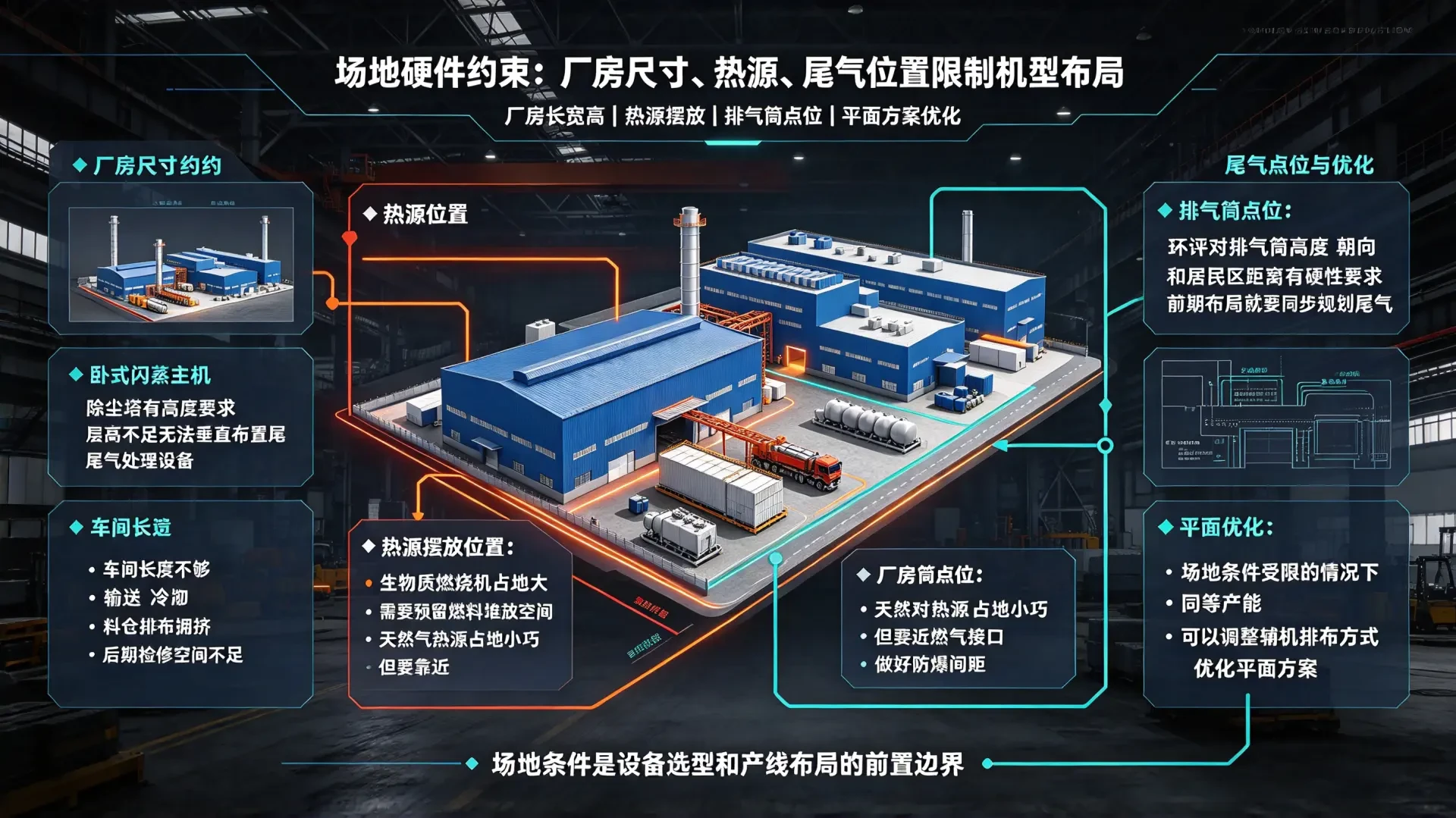
五、场地硬件约束:厂房尺寸、热源、尾气位置限制机型布局
产能达标,还要放得下、装得顺:
1.厂房长宽高:卧式闪蒸主机、除尘塔有高度要求;层高不足,无法垂直布置尾气处理设备;车间长度不够,输送、冷却、料仓排布拥挤,后期检修空间不足;
2.热源摆放位置:生物质燃烧机占地大,需要预留燃料堆放空间;天然气热源占地小巧,但要靠近燃气接口,做好防爆间距;
3.排气筒点位:环评对排气筒高度、朝向、和居民区距离有硬性要求,前期布局就要同步规划尾气管路走向;场地条件受限的情况下,同等产能,我们可以调整辅机排布方式,优化平面方案。
V. Site Constraints: Workshop Dimensions, Heat Source and Exhaust Layout Affect Equipment Arrangement
A properly sized dryer must also fit and be installed smoothly:
Workshop dimensions: Horizontal flash main units and dust scrubbers have height requirements. Insufficient floor height prevents vertical installation of tail gas treatment equipment. Inadequate workshop length leaves cramped space for conveyors, coolers and silos and hinders later maintenance.
Heat source layout: Biomass burners occupy a large footprint and require dedicated fuel storage space. Natural gas heating systems are compact but need proximity to gas pipelines and compliant explosion-proof clearances.
Exhaust stack: Environmental assessment imposes strict requirements on stack height, orientation and separation distance from residential areas. Tail gas pipelines must be planned at the early design stage. When site space is limited, auxiliary equipment layout can be optimised for the same rated capacity.
六、分期扩产方案:先小后大,预留升级空间
很多客户资金分批投入,打算先上线一套小产线试运行,后续存栏扩大、新增收粪业务再扩容,有两种稳妥方案:
方案一:主机先上基础机型,前端上料、后端除尘除臭、引风机管路按更大一档产能选型预留,后期直接更换主机转子组件 / 升级主机,辅机不用全部换新;
方案二:预留第二台主机安装位置,配套公用尾气处理系统、热源、料仓,后期直接增加一条主机。 不建议前期把所有配套按最小产能做死,后期扩产容易风量负压不匹配,整套尾气系统要重新改造,成本很高。
VI. Phased Capacity Expansion Plan: Start Small and Reserve Upgrade Space
Many clients invest in phases, commissioning a small line for trial operation first and expanding later as livestock inventory grows or outsourced manure business expands. Two reliable solutions are available:
Option 1: Install a basic main unit first, while sizing the front feeding system, back-end dust removal/deodorisation and induced draft piping for a higher capacity tier. Later upgrades only require replacing the rotor assembly of the main unit without full replacement of all auxiliary equipment.
Option 2: Reserve foundation space for a second main unit and share common tail gas treatment, heat source and silo facilities for future expansion.
It is not recommended to design all supporting systems strictly for the minimum initial capacity. Later expansion may cause mismatched air volume and negative pressure, requiring costly reconstruction of the entire exhaust system.
七、蛋鸡粪VS 肉鸡粪:物料特性差异,选型细节区别
1.蛋鸡粪:饲料添加石粉,粪便钙含量高、比重更大、粘性强,烘干后偏硬;容易沉积在腔体底部;选型时重点确认打散转子强度、耐磨叶片配置,防止快速磨损;
2.肉鸡粪:混大量垫料、鸡毛、秸秆纤维,纤维长,容易缠绕主轴;优先选配加强型前置预打散装置,调高打散转速,避免缠轴堵料;同样存栏量,肉鸡粪和蛋鸡粪虽然重量接近,但工况难点不一样,不能直接套用同一套配置。
VII. Layer Manure vs. Broiler Manure: Material Differences and Selection Details
Layer manure: High calcium content from limestone feed additives, higher density and strong adhesion. Dried material tends to be hard and settle at the bottom of the cylinder. Priority should be given to rotor strength and wear-resistant blades to avoid rapid abrasion.
Broiler manure: Mixed with large amounts of bedding material, chicken feathers and long straw fibres, which easily wrap around the main shaft. Reinforced pre-breaking devices and higher breaking speed are recommended to prevent shaft winding and blockages.
For the same livestock inventory, broiler and layer manure have similar weight but present different operational challenges, so the same configuration cannot be directly adopted for both.
八、完整对接流程
您只需要提供 4 项基础信息,我们免费核算产能、出具平面布局方案:
① 养殖类型(蛋鸡 / 肉鸡)+ 现存栏数量;
② 清粪方式(干清粪 / 水冲粪)、鲜粪大致含水率;
③ 每日计划开机时长,后端用途(场内自用 / 有机肥外销);
④ 车间尺寸、热源意向(生物质 / 天然气)、厂区距离居民区远近。
我们根据数据测算合理时产,给出机型推荐,配套工艺图纸,避免选型偏大或者偏小。
VIII. Full Cooperation Process
You only need to provide four sets of basic information, and we will calculate capacity free of charge and draw layout plans:
① Type of poultry (layer / broiler) + current inventory
② Manure cleaning method (dry cleaning / flush cleaning) and approximate moisture of fresh manure
③ Planned daily operating hours and downstream application (on-site use / organic fertiliser sales)
④ Workshop dimensions, preferred heat source (biomass / natural gas), and distance from the plant to residential zones
We will calculate the reasonable hourly throughput based on your data, recommend suitable models and provide process drawings to avoid over-sizing or under-sizing.
结语
如果你正在核算自家鸡场需要多大的烘干产线,拿不准该选哪一档卧式闪蒸机型,可以把存栏、车间条件发给我们,金万泓机械免费为您做产能测算和平面布局方案。
If you are calculating the required scale of a manure drying line and uncertain which tier of horizontal flash dryer to choose, send us your livestock inventory and site conditions. Jinwanhong Machinery provides free capacity calculation and workshop layout design services.