【引言】
中药饮品加工厂、中药提取产业园在生产加工过程中,会持续产出大量新鲜中药药渣。这类物料水分含量高、有机质丰富、含糖量大,存放时间稍长就会快速发酵发酸、腐烂发臭,不仅占用大量仓储堆放场地,还极易引发异味信访投诉。高额的危废处置费用,长期成为中药生产企业沉重的成本负担。如何无害化处置药渣,把废弃药渣转化为可利用资源,是众多中药加工企业亟待解决的固废难题。
Chinese herbal drink processing plants and Chinese medicine extraction industrial parks continuously generate large volumes of fresh herbal residues during production and processing. This type of material features high moisture content, abundant organic matter and high sugar content. If stored for even a short period, it rapidly ferments, turns sour, rots and emits foul odours. It not only occupies massive storage and stacking space but also easily triggers public complaints over odour nuisances. The high cost of hazardous waste disposal has long been a heavy financial burden for Chinese medicine manufacturers. How to dispose of herbal residues harmlessly and convert discarded residues into usable resources is an urgent solid waste challenge for numerous Chinese medicine processing enterprises.
一、中药加工行业痛点:鲜药渣处置难,环保成本居高不下
中药提取后的新鲜药渣,含水率高,物料质地松软,内部残留大量糖分与有机质,具备快速发酵的条件。一旦集中堆放,短时间内就会升温霉变,滋生异味与蚊虫。厂区周边居民投诉、环保部门现场核查风险持续存在。
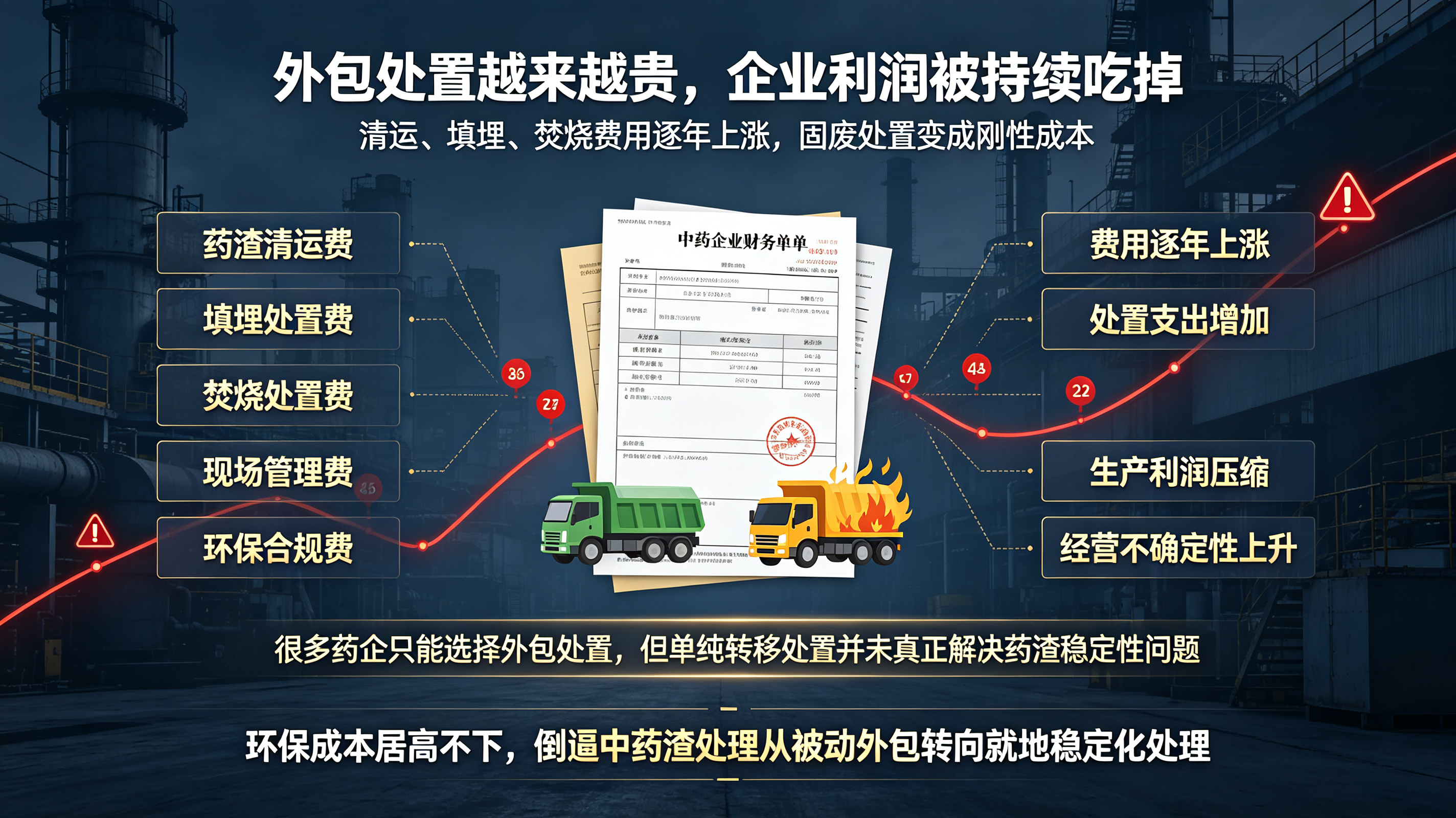
很多药企只能选择外包处置,药渣清运、填埋、焚烧费用逐年上涨,固废处置支出持续压缩企业生产利润。单纯堆放治标不治本,一旦管控不当,还会面临渗滤液污染土壤地下水、环保行政处罚等一系列风险。
I. Pain Points in the Chinese Medicine Processing Industry: Difficult Disposal of Fresh Herbal Residues and Sustained High Environmental Costs
Fresh herbal residues left after Chinese medicine extraction have high moisture content and a soft texture, retaining large amounts of sugar and organic matter inside, creating ideal conditions for rapid fermentation. Once stockpiled in bulk, they heat up and turn mouldy within a short time, giving rise to unpleasant odours and breeding mosquitoes and flies. Enterprises face persistent risks of complaints from nearby residents and on-site inspections by environmental authorities.
Many pharmaceutical enterprises have no choice but to outsource disposal. Expenses for haulage, landfilling and incineration of herbal residues rise year by year, and solid waste handling costs keep squeezing production profits. Simple stockpiling offers only a temporary fix. Poor management may lead to leachate contaminating soil and groundwater, alongside administrative penalties for environmental violations.
二、传统处置方式短板重重,难以实现规模化资源化利用
不少企业尝试过多种处置手段,但均存在明显短板:
✅ 露天自然晾晒:极度依赖天气,占地面积巨大。阴雨天气物料无法干燥,晾晒过程粉尘、异味扩散,环保管控不允许,无法稳定连续生产;
✅ 直接填埋处理:填埋成本高昂,大量有机质药渣会造成土地污染,多地已经收紧填埋准入,长期不可持续;
✅ 焚烧处置:能耗成本高,药渣热值偏低,焚烧产生烟气需要复杂尾气处理,项目审批难度大,不符合循环经济发展导向。
传统方案大多只解决“扔掉药渣”的问题,无法挖掘药渣内在价值,固废只能纯消耗,没有收益回报。
II. Severe Shortcomings of Conventional Disposal Methods, Hindering Large-Scale Resource Utilisation
Many enterprises have tested various disposal approaches, yet all carry obvious drawbacks: ✅ Open-air natural sun-drying: Heavily weather-dependent and land-intensive. Material cannot dry on rainy days; dust and odour spread during drying, which fails environmental control requirements and prevents stable continuous production. ✅ Direct landfilling: High landfill costs. Organic-rich herbal residues cause land pollution. Many regions have tightened landfill access, making this method unsustainable in the long run. ✅ Incineration: High energy consumption. Herbal residues have low calorific value, and flue gas from incineration requires complex tail gas treatment. Project approval is difficult, and this option conflicts with the development direction of circular economy.
Most traditional solutions merely address the problem of “getting rid of herbal residues” and fail to tap their inherent value. Solid waste becomes a pure cost burden with no revenue returns.
三、金万泓三回程烘干机,低温梯度烘干,适配药渣物料特性
针对中药药渣高含水、含糖易焦、质地松软易破碎的物料特点,金万泓三回程烘干机采用多层套筒循环换热工艺,主打低温梯度烘干模式。热风在筒体内多次循环换热,热利用率高,烘干效率稳定,避免高温瞬间灼烧物料,做到烘干不焦料,最大程度保留药渣内部残余有机质。
设备搭载专为药渣研发的专用柔性扬料结构,在提升、翻动物料过程中,轻柔打散结团药渣,避免过度破碎造成物料粉末化,同时有效缓解药渣粘壁结块难题,物料受热均匀,出料含水率稳定可控,彻底解决干湿不均的行业痛点。
整套产线可配套密闭除尘系统,生产过程超低扬尘,密闭作业抑制异味扩散,生产现场整洁可控,满足厂区环保生产要求。
III. Jinwanhong Three-Pass Dryer: Low-Temperature Gradient Drying Adapted to Herbal Residue Properties
Targeting the characteristics of herbal residues — high moisture, high sugar content prone to scorching, soft texture and fragility — Jinwanhong three-pass dryers adopt a multi-sleeve circulating heat exchange process centred on low-temperature gradient drying. Hot air circulates and exchanges heat multiple times inside the cylinder for high heat utilisation and stable drying efficiency. Instant high-temperature burning of materials is avoided; residues are dried without scorching, preserving the maximum amount of residual organic matter.
The equipment is fitted with a specialised flexible material lifting structure developed exclusively for herbal residues. As materials are lifted and tumbled, agglomerated residues are gently broken up to prevent excessive pulverisation into fine powder. It also effectively mitigates wall adhesion and caking of herbal residues. Materials are heated evenly, and the moisture content of output is stably controllable, thoroughly resolving the industry pain point of uneven drying.
The complete production line can be equipped with a closed dust removal system to minimise dust emission during operation. Closed operation suppresses odour diffusion, maintaining a clean and controllable production site and meeting the plant’s environmental production requirements.
四、烘干药渣两大资源化方向,固废转化为可销售增值物料
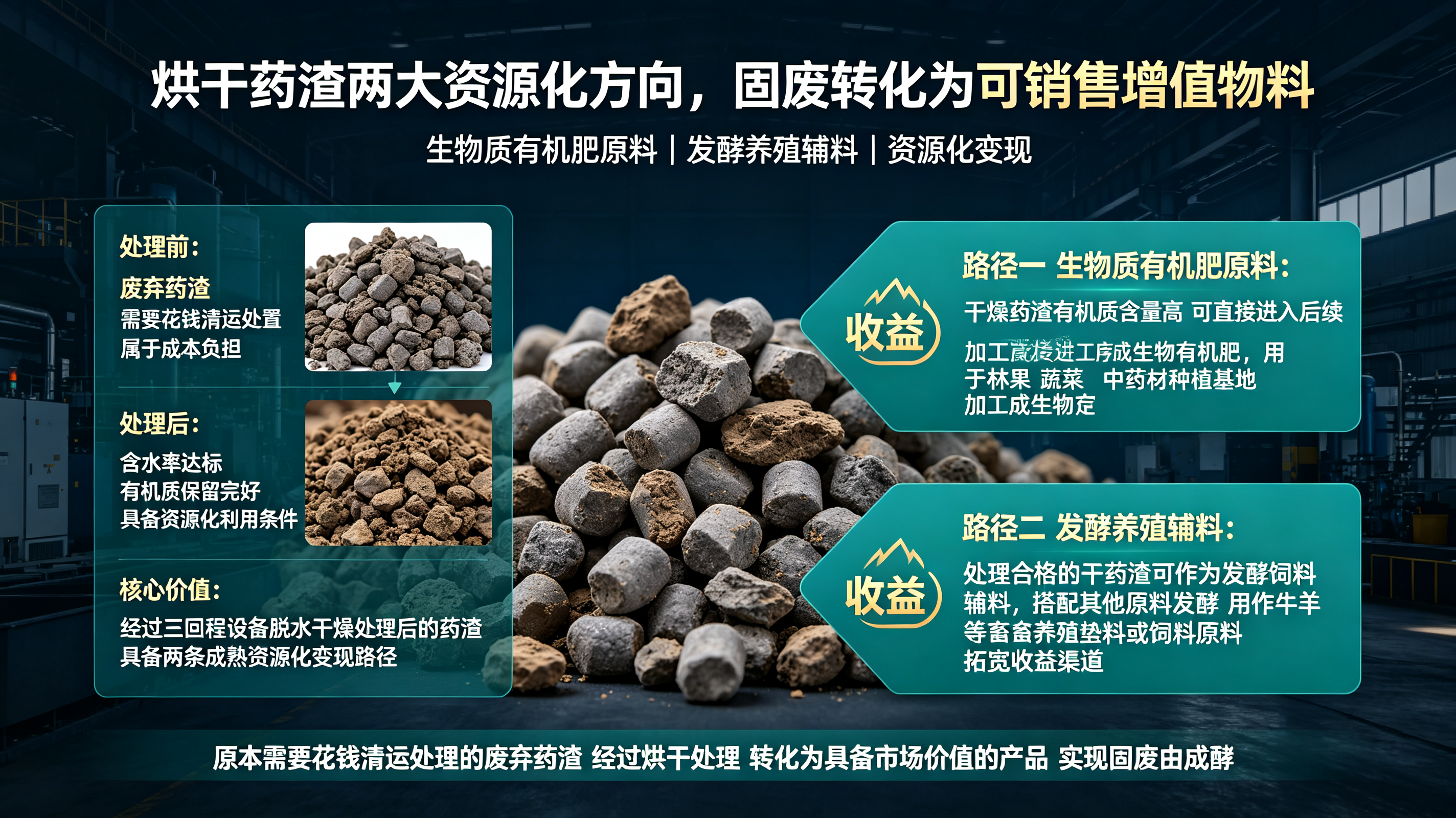
经过三回程设备脱水干燥处理后的药渣,含水率达标、有机质保留完好,具备两条成熟资源化变现路径:
生物质有机肥原料:干燥药渣有机质含量高,可直接进入后续发酵工序,加工成生物有机肥,用于林果、蔬菜、中药材种植基地,市场需求稳定;
发酵养殖辅料:处理合格的干药渣可作为发酵饲料辅料,搭配其他原料发酵,用作牛羊等畜禽养殖垫料或饲料原料,拓宽收益渠道。
原本需要花钱清运处理的废弃药渣,经过烘干处理,转化为具备市场价值的产品,实现固废由“成本负担”转变为企业增收资源。
IV. Two Major Resource Utilisation Pathways for Dried Herbal Residues: Converting Solid Waste into Marketable Value-Added Materials
After dehydration and drying by the three-pass dryer, herbal residues meet moisture standards and retain intact organic matter, supporting two mature monetisation routes for resource utilisation:
Raw material for biomass organic fertiliser: Dried herbal residues are high in organic matter and can directly enter subsequent fermentation processes to produce bio-organic fertiliser for fruit, forest, vegetable and Chinese medicinal herb planting bases with steady market demand.
Fermentation auxiliary material for breeding: Qualified dried herbal residues can serve as auxiliary raw materials for fermented feed. Mixed with other raw materials for fermentation, they can be used as bedding or feed ingredients for livestock such as cattle and sheep, expanding revenue channels.
Discarded herbal residues, which once required payment for haulage and disposal, are transformed into marketable products after drying. Solid waste shifts from a “cost burden” into a revenue-generating resource for enterprises.
五、适配场景:中药产业园、饮片厂、药渣集中处理中心成套自动化产线
金万泓可提供从进料输送、烘干主机、除尘除臭、出料仓储一体化成套自动化产线方案。方案适配中小型饮品加工厂,也可承接大型中药产业园、区域性药渣集中固废处理中心项目,可根据每日药渣产出量,定制匹配产能的成套设备。
整套设备自动化程度高,人工投入少,可实现24小时连续稳定作业,匹配中药企业不间断生产产生药渣的工况,做到药渣日产日处理,无需长期大量堆存。
V. Applicable Scenarios: Complete Automated Production Lines for Chinese Medicine Industrial Parks, Herbal Drink Plants and Centralised Herbal Residue Treatment Centres
Jinwanhong delivers integrated automated production line solutions covering feeding and conveying, drying main units, dust and odour removal, and discharging and warehousing. The solutions suit small and medium-sized herbal drink processing factories and can also undertake projects for large Chinese medicine industrial parks and regional centralised solid waste treatment centres for herbal residues. Complete equipment can be customised according to daily herbal residue output to match required capacity.
The full set of equipment features high automation and low labour input, supporting 24-hour continuous stable operation. It matches the working conditions of uninterrupted herbal residue generation at Chinese medicine enterprises, achieving same-day generation and same-day disposal without long-term large-scale stockpiling.
六、节能低碳,契合无废工厂、工业固废循环项目建设标准
三回程循环换热结构,热量多次回收利用,相比传统单筒烘干设备能耗更低,节能优势突出。整套产线扬尘、异味可控,工艺路线符合工业固废减量化、无害化、资源化政策导向。
项目建设可对接无废工厂创建、工业固废综合利用相关项目申报,配套完整设备资质资料,助力中药企业完成环保技改,打通药渣资源化循环链路。
金万泓机械,专注疑难固废烘干解决方案,可提供免费物料试机、现场勘测、定制成套药渣烘干方案,助力中药企业解决药渣腐臭难题,实现固废资源化增收。
VI. Energy-Saving and Low-Carbon, Aligned with Standards for Zero-Waste Factories and Industrial Solid Waste Recycling Projects
The three-pass circulating heat exchange structure recovers and reuses heat multiple times, delivering lower energy consumption and prominent energy-saving advantages compared with traditional single-cylinder drying equipment. Dust and odour from the whole line are controllable. The process complies with policy guidelines for the reduction, harmless treatment and resource utilisation of industrial solid waste.
Projects can apply for initiatives including zero-waste factory development and comprehensive utilisation of industrial solid waste. Complete equipment qualification documents are provided to support Chinese medicine enterprises in completing environmental technical upgrades and building a circular resource utilisation chain for herbal residues.
Jinwanhong Machinery specialises in drying solutions for difficult solid waste. We offer free material test runs, on-site surveys and customised complete herbal residue drying schemes to help Chinese medicine enterprises resolve the problem of rotting and smelly herbal residues and achieve revenue growth through solid waste resource utilisation.