【引言】
2026年,无废农业、畜禽粪污资源化利用政策持续加码。农业农村局、生态环境局多部门同步发文,一边收紧环保监管红线,一边释放真金白银扶持红利。不少规模化养殖场、家庭农场抓住窗口期,完成粪污无害化烘干技改,申领项目补贴,叠加税收优惠,既完成环保合规,又实现粪污变资源。
很多养殖老板还不清楚:哪些项目可以申报补贴、申报门槛是什么、税收减免如何落地,设备选型不符合标准,即便建好项目也无法通过验收、拿不到补助。今天一文读懂2026养殖固废资源化改造全部红利,帮大家避开申报误区,抢抓政策窗口期。
In 2026, policies for zero-waste agriculture and the resource utilisation of livestock and poultry manure continue to be strengthened. Multiple government departments including the Bureau of Agriculture and Rural Affairs and the Bureau of Ecology and Environment have issued documents simultaneously. While tightening the red line for environmental supervision, they are also releasing substantial financial support benefits. Many large-scale breeding farms and family farms have seized this window of opportunity to complete harmless drying technical transformation of manure, apply for project subsidies and stack preferential tax policies. They have achieved environmental compliance while turning manure into usable resources.
Many farm operators remain unaware which projects qualify for subsidy applications, what the application thresholds are, and how tax reductions and exemptions can be implemented. If the selected equipment fails to meet standards, even completed projects cannot pass acceptance and obtain subsidies. Today’s article fully explains all benefits of the 2026 breeding solid waste resource transformation, helping you avoid application pitfalls and seize the policy window.
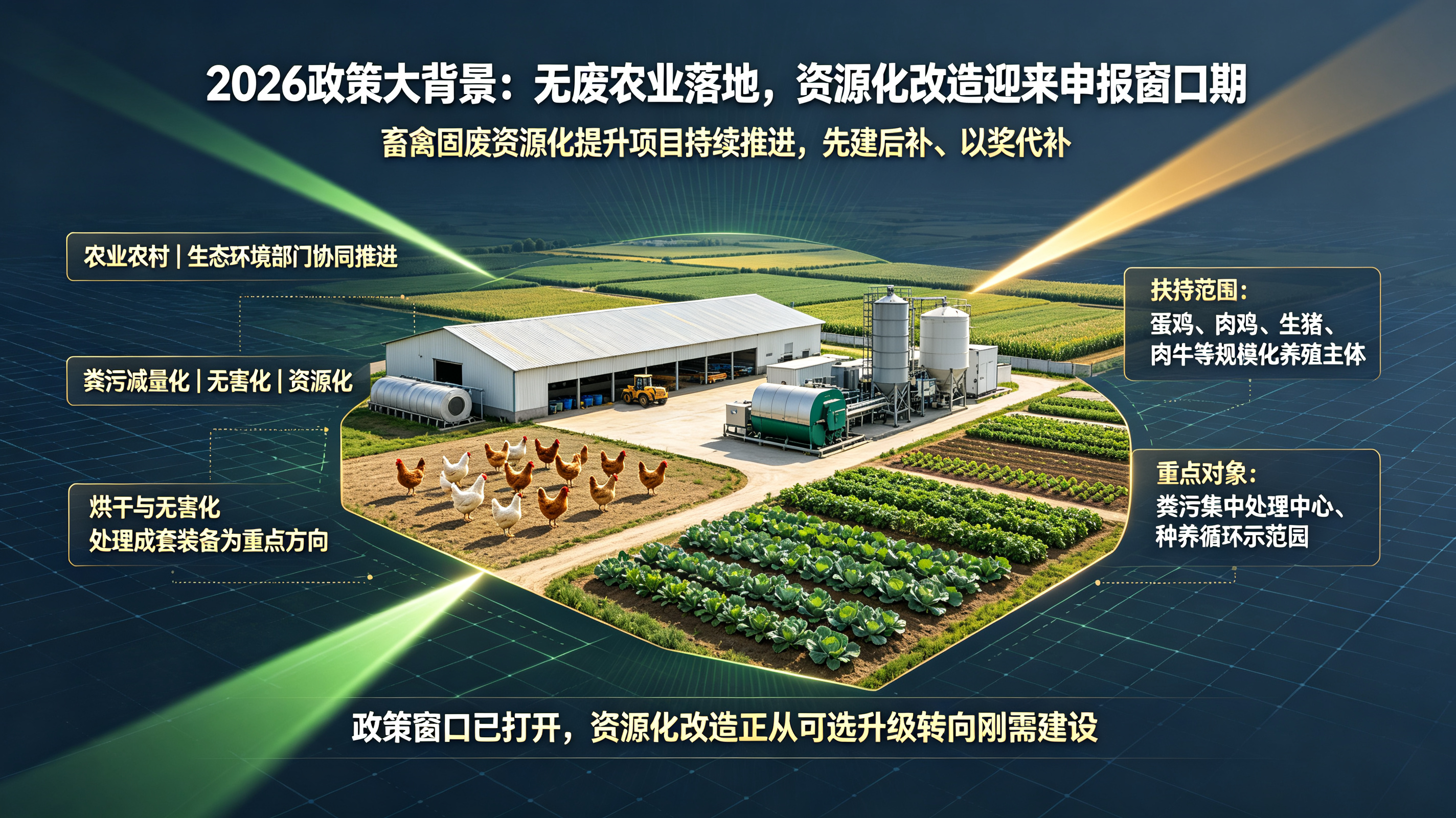
一、2026政策大背景:无废农业落地,资源化改造迎来申报窗口期
围绕畜禽养殖污染治理、种养循环体系建设,2026地方农业农村、生态环境部门持续推进畜禽固废资源化提升项目,鼓励养殖场配套标准化无害化处理装备,推动粪污减量化、无害化、资源化。政策采用先建后补、以奖代补的核心模式,扶持范围覆盖蛋鸡、肉鸡、生猪、肉牛等各类规模化养殖主体,粪污集中处理中心、种养循环示范园为重点扶持对象。
政策导向清晰:不再只停留在简单防渗、堆存设施建设,重点支持烘干、无害化处理等成套装备技改,从源头解决粪污堆积、恶臭、渗滤液污染等环保痛点,打通粪肥还田资源化闭环。
I. General Policy Background for 2026: Rollout of Zero-Waste Agriculture Opens the Application Window for Resource Transformation
Focusing on livestock and poultry pollution control and the construction of planting-breeding circulation systems, local departments of agriculture, rural affairs and ecology and environment will keep promoting upgrading projects for the resource utilisation of livestock solid waste in 2026. Farms are encouraged to install standardised harmless treatment equipment to realise manure reduction, harmless treatment and resource utilisation. The core policy model adopts construction first, subsidy afterwards and rewards in lieu of subsidies. The support scope covers various large-scale breeding entities including layer farms, broiler farms, pig farms and beef cattle farms. Manure centralised treatment centres and planting-breeding circulation demonstration parks are key supported targets.
The policy direction is clear: it is no longer limited to simple anti-seepage and storage facility construction. Priority is given to technical transformation of complete sets of equipment such as drying and harmless treatment, to fundamentally resolve environmental pain points including manure accumulation, foul odour and leachate pollution, and close the resource recycling loop for manure returning to farmland.
二、三重政策红利,设备改造可叠加享受
红利一:粪污无害化烘干设备技改专项补贴,最高可达总投资50%
畜禽粪污资源化改造项目,包含烘干主机、热源、除尘除臭、输送成套设备购置与工程改造,纳入地方专项扶持范围。符合申报条件的项目,补助比例最高可申领项目总投资的50%,大幅降低养殖场设备升级投入成本。项目实行先建设、后验收、再拨付补贴,需要设备、资料、现场工况全部达标,方可顺利申领资金。
红利二:固废综合利用项目,增值税、企业所得税双重减免
完成粪污资源化处置、有机肥生产的养殖主体,可享受资源综合利用税收优惠。生产销售有机肥产品免征增值税;符合资源综合利用目录要求,还可享受增值税即征即退政策。环保节能节水类项目,可享受企业所得税“三免三减半”优惠,进一步降低企业长期运营税负。
红利三:养殖园区、粪污集中处理中心专项奖补资金
针对规模化养殖产业园、区域性粪污集中处理中心、种养循环示范基地,各地设置专项奖补资金。鼓励多家养殖场共建集中处置站点,统一收集周边散户粪污集中烘干、制肥还田,形成区域循环模式。这类示范项目不仅补贴力度更大,还可优先纳入地方示范项目名录,便于后续绿色信贷、项目申报。
II. Three-Tier Policy Benefits: Stackable Benefits for Equipment Renovation
Benefit 1: Special subsidy for technical transformation of manure harmless drying equipment, up to 50% of total investment Livestock and poultry manure resource transformation projects, covering the purchase and engineering renovation of drying main units, heat sources, dust and odour removal systems and conveying equipment, fall within the scope of local special support. Eligible projects can receive subsidies up to 50% of the total project investment, greatly cutting farms’ capital expenditure for equipment upgrading. Projects follow the process of construction first, acceptance afterwards and subsequent subsidy disbursement. Subsidies can only be obtained smoothly when equipment, documents and on-site operating conditions all meet standards.
Benefit 2: Dual reductions of VAT and corporate income tax for solid waste comprehensive utilisation projects Breeding entities that complete manure resource disposal and organic fertiliser production can enjoy preferential tax policies for comprehensive resource utilisation. VAT is exempted for the production and sale of organic fertiliser products. Where requirements in the Comprehensive Resource Utilisation Catalogue are met, VAT refund upon payment can also be applied. Environmental protection, energy-saving and water-saving projects qualify for the “three-year exemption and three-year half-reduction” corporate income tax incentive, further lowering long-term corporate tax burdens.
Benefit 3: Special reward and subsidy funds for breeding parks and manure centralised treatment centres Special reward and subsidy funds are set up across regions for large-scale breeding industrial parks, regional manure centralised treatment centres and planting-breeding circulation demonstration bases. Multiple farms are encouraged to jointly build centralised disposal stations to collect manure from surrounding small-scale farmers, conduct centralised drying and fertiliser production for farmland return, forming a regional circular model. Such demonstration projects enjoy higher subsidy intensity and priority inclusion in local demonstration project lists, facilitating subsequent applications for green credit and other projects.
三、环保硬性新规:规模化养殖场必须配套标准化烘干处置设备
监管常态化背景下,规模化养殖场粪污露天堆置、简易贮存的旧模式已不再适用。新规明确,规模场需要配套与养殖产能匹配的无害化处置设施,杜绝粪污长期堆置、雨水冲刷外溢、恶臭扰民等问题。
仅依靠堆肥、简单晾晒,受天气制约大,无法稳定实现粪污无害化,极易在环保巡查、信访核查中被责令限期整改,甚至产生处罚。配套标准化密闭烘干设备,可就地对鲜粪脱水灭菌,减少粪污堆存占地,从源头消除渗滤液、异味污染风险,满足现行环保核查硬性要求。
III. Mandatory New Environmental Rules: Large-Scale Farms Must Be Equipped with Standardised Drying and Disposal Equipment
Against the backdrop of regularised supervision, the old model of open-air stacking and simple storage of manure at large-scale farms is no longer acceptable. New regulations specify that large-scale farms must install harmless treatment facilities matching their breeding capacity to eliminate long-term manure stockpiling, overflow caused by rainwater washing and odour nuisances.
Relying merely on composting or simple sun-drying is heavily weather-dependent and cannot achieve stable harmless treatment of manure. It is highly likely to result in orders for rectification within a time limit or even penalties during environmental inspections and public complaint investigations. Installing standardised enclosed drying equipment enables on-site dehydration and sterilisation of fresh manure, reduces land occupation for manure storage, eliminates risks of leachate and odour pollution at the source, and meets the mandatory requirements of current environmental audits.
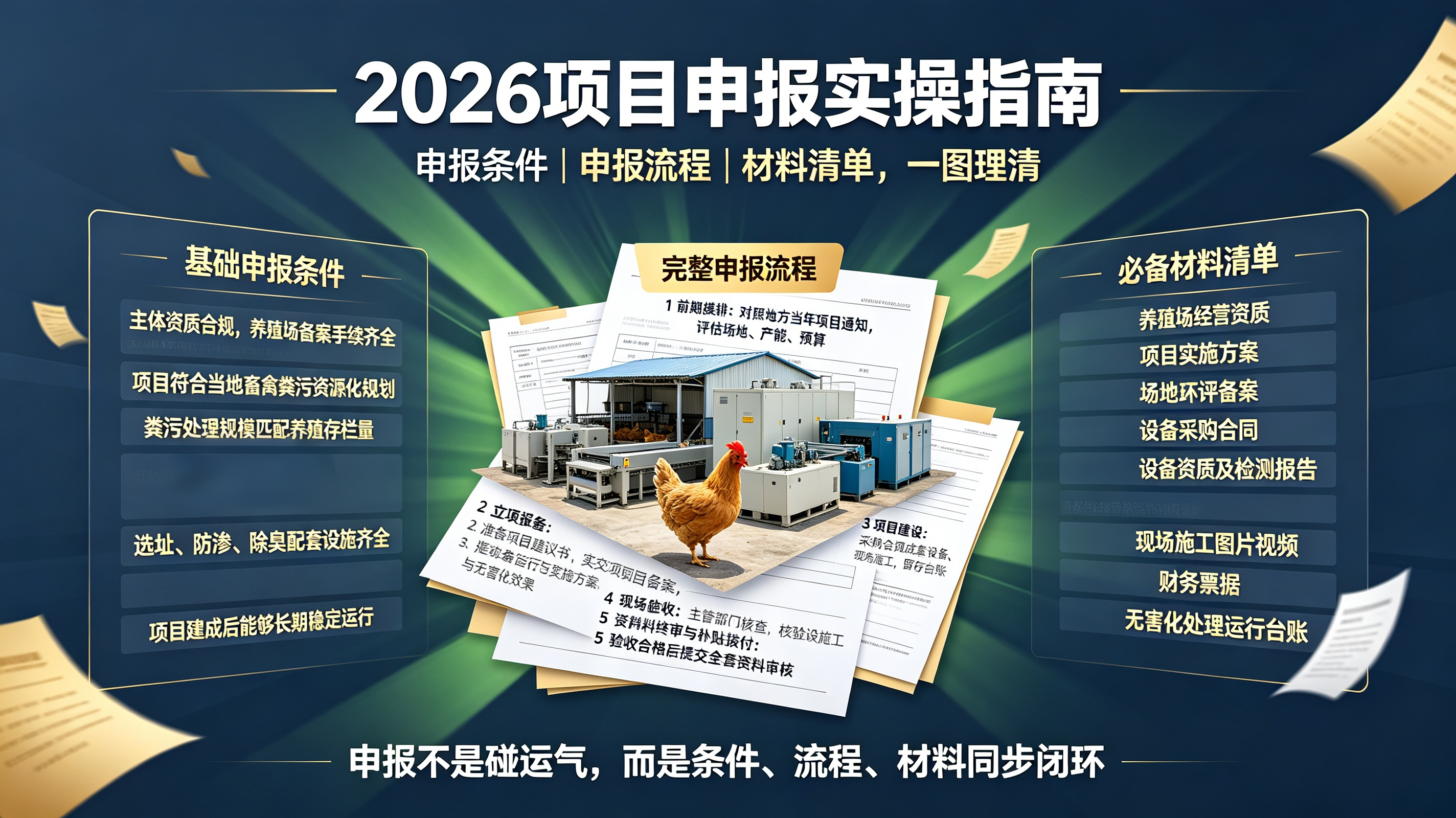
四、2026项目申报实操指南:申报条件、流程、材料清单
✅ 基础申报条件
主体资质合规,养殖场备案手续齐全;项目符合当地畜禽粪污资源化规划;粪污处理规模匹配养殖存栏量;选址、防渗、除臭配套设施齐全,项目建成后能够长期稳定运行。
✅ 完整申报流程
1.前期摸排:对照地方当年项目通知,评估自身场地、产能、预算是否符合申报门槛;
2.立项报备:准备项目建议书、实施方案,向农业农村主管部门提交项目备案;
3.项目建设:采购合规成套设备、现场施工,留存合同、发票、施工影像台账;
4.现场验收:项目完工后,迎接主管部门现场核查,核验设备运行、无害化效果;
5.资料终审与补贴拨付:验收合格后提交全套资料审核,完成补贴资金拨付。
✅ 必备材料清单
养殖场经营资质、项目实施方案、场地环评备案、设备采购合同、设备资质及检测报告、现场施工图片视频、财务票据、无害化处理运行台账等。
IV. Practical Guide for 2026 Project Application: Eligibility, Procedures and Document Checklist
✅ Basic Application Eligibility The entity holds compliant qualifications with complete farm filing formalities; the project aligns with local livestock and poultry manure resource utilisation plans; manure treatment capacity matches the livestock inventory; site selection, anti-seepage, odour removal and supporting facilities are complete, and the project can operate stably for a long time upon completion.
✅ Complete Application Process
Preliminary assessment: Evaluate whether your site, production capacity and budget meet the application thresholds in accordance with the annual local project notice.
Project initiation and filing: Prepare project proposals and implementation plans and submit project filing to the competent agriculture and rural affairs authority.
Project construction: Purchase compliant complete sets of equipment and carry out on-site construction; keep contracts, invoices and construction image records.
On-site acceptance: After project completion, undergo on-site inspection by competent authorities to verify equipment operation and harmless treatment effects.
Final document review and subsidy disbursement: Submit full documents for review after passing acceptance to complete the release of subsidy funds.
✅ Mandatory Document Checklist Farm business qualifications, project implementation plan, site EIA filing, equipment procurement contracts, equipment qualifications and test reports, on-site construction photos and videos, financial invoices, operation logs of harmless treatment and so on.
五、真实获批客户案例参考
2026年省内多家规模化蛋鸡养殖基地,采用金万泓卧式闪蒸粪污烘干成套产线,完成粪污无害化技改。项目配套密闭除臭除尘系统,建成标准化粪污就地处置车间,顺利通过农业农村、生态环境部门联合验收,成功申领粪污资源化改造专项补贴。
改造完成后,养殖场一方面消除雨季粪污堆积、异味扰民的环保风险;另一方面产出稳定合格干鸡粪原料,自用还田降低化肥采购成本,对外销售有机肥原料获得额外收益,实现环保达标+项目补贴+资源化增收三重收益。
V. Reference of Approved Customer Cases
In 2026, multiple large-scale layer breeding bases in the province adopted Jinwanhong horizontal flash manure drying complete production lines to finish harmless manure technical transformation. Equipped with enclosed odour and dust removal systems, the projects built standardised on-site manure disposal workshops, successfully passed joint acceptance by the agriculture, rural affairs and ecology and environment authorities and obtained special subsidies for manure resource transformation.
After renovation, the farms on one hand eliminated environmental risks such as manure accumulation in rainy seasons and odour complaints; on the other hand, they produced stable and qualified dried chicken manure raw materials. The dried manure can be used for on-site farmland return to reduce chemical fertiliser procurement costs and sold externally as organic fertiliser raw materials for extra income, achieving triple benefits: environmental compliance, project subsidies and revenue from resource utilisation.
结语
政策窗口期有限,各地申报名额、截止时间各不相同。想要申报2026畜禽固废资源化改造项目,要提前规划方案、选定合规设备,预留施工与资料准备周期。
金万泓机械,源头烘干设备厂家,可根据养殖场存栏规模、场地条件,定制粪污烘干成套方案,配套全套设备资质资料,一站式助力项目落地、验收申报。
The policy window is limited, and application quotas and deadlines vary by region. If you plan to apply for the 2026 livestock solid waste resource transformation project, plan the scheme in advance, select compliant equipment and reserve time for construction and document preparation.
Jinwanhong Machinery, a manufacturer of drying equipment, can customise complete manure drying solutions based on farm livestock inventory and site conditions, provide full sets of equipment qualification documents, and offer one-stop support for project delivery, acceptance and application.