【引言】
食用菌工厂化规模不断扩大,每年产生巨量废菌渣。湿菌渣堆积发霉腐烂,随意堆放既污染场地,又容易引来环保督查;直接丢弃更是白白浪费宝贵有机质资源。不少食用菌基地正被菌渣处置难题困扰。金万泓三回程烘干机,把废弃菌渣加工成高价值原料,变废为宝,打通食用菌产业循环经济链路。
Introduction
With the continuous expansion of industrialized edible fungus cultivation, massive amounts of spent mushroom substrate are generated every year. Piled wet mushroom residue tends to mildew and rot. Random stockpiling not only pollutes plant sites but also triggers environmental supervision inspections, while direct disposal results in a total waste of valuable organic matter resources. Numerous edible fungus bases are plagued by the dilemma of spent mushroom residue treatment.
Jinwanhong triple-pass dryer processes waste mushroom residue into high-value raw materials, realizes waste recycling, and completes the circular economy chain for the edible fungus industry.
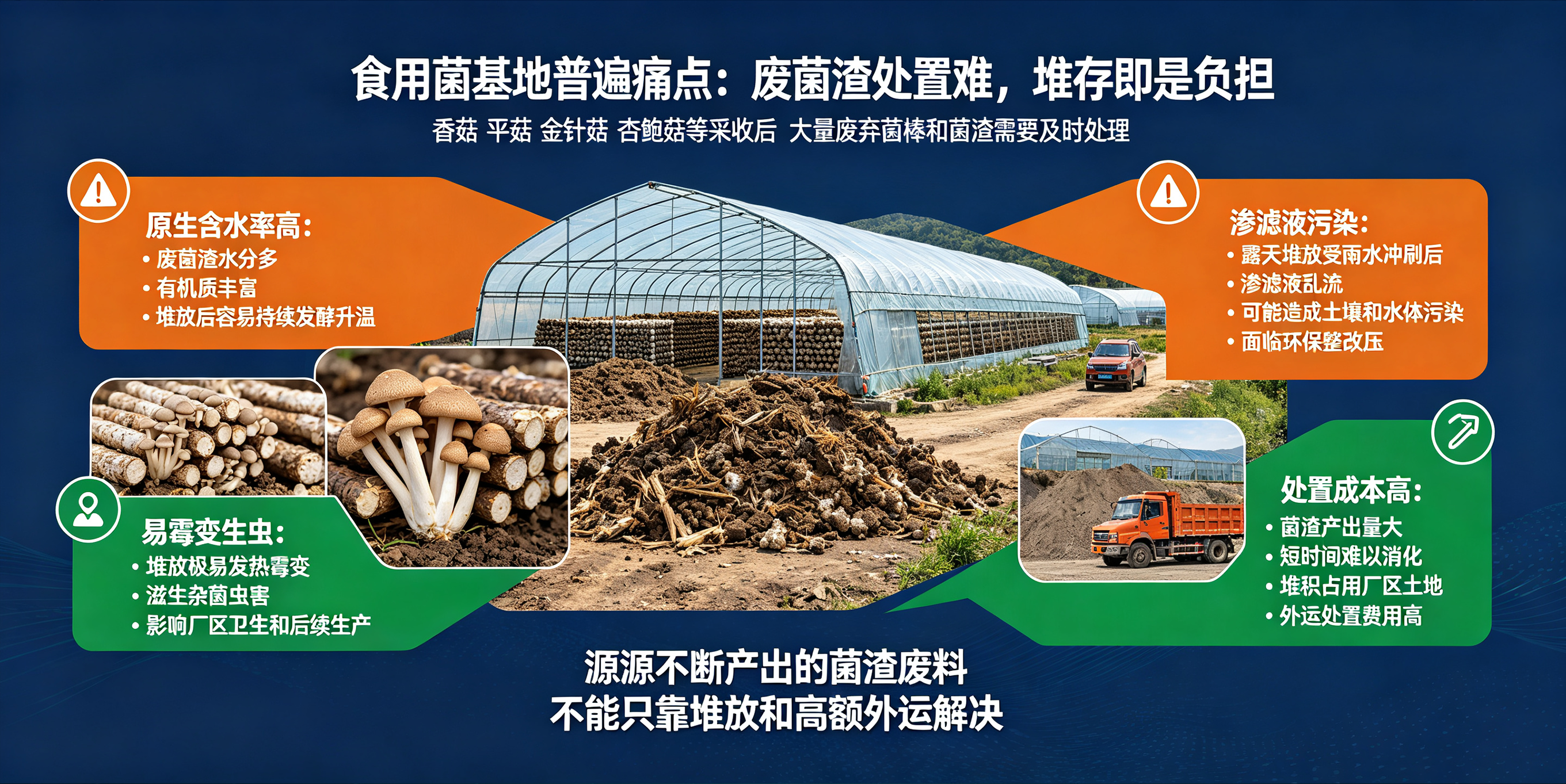
一、食用菌基地普遍痛点:废菌渣处置难,堆存即是负担
香菇、平菇、金针菇、杏鲍菇等食用菌采收完成后,会产生大量废弃菌棒、菌渣。废菌渣原生含水率高,有机质丰富,堆放极易发热霉变、滋生杂菌虫害,露天堆放雨水冲刷后渗滤液乱流,造成土壤、水体污染,面临环保整改压力。
很多基地菌渣产出量大,短时间无法消化,堆积占用大量厂区土地,外运处置又要承担高额清运处理费用。一边是源源不断产出的菌渣废料,一边是无处安放、处置成本高企,成为众多食用菌产业园头疼的现实难题。
I. Universal Pain Point for Edible Fungus Bases: Difficult Spent Substrate Disposal and Burdensome Stockpiling
Large quantities of waste fungus sticks and substrate are left after the harvesting of shiitake, oyster, enoki, pleurotus eryngii and other edible fungi. With high initial moisture content and rich organic content, raw spent mushroom substrate is extremely prone to heating, mildewing, and breeding miscellaneous bacteria and pests after stacking. Open‑air stockpiling, when washed by rainwater, produces uncontrolled leachate that contaminates soil and water bodies, bringing huge risks of environmental rectification.
Most fungus bases generate massive volumes of spent substrate that cannot be fully processed in a timely manner. Long‑term stacking occupies valuable factory land, while outsourced transportation and disposal incur high recurring costs. Continuous waste output on the one hand, and limited disposal space plus rising processing costs on the other, has become a common and troublesome dilemma for edible fungus industrial parks.
二、传统晾晒模式短板突出,无法适配规模化生产
很多基地选择露天自然晾晒处理菌渣,但是弊端十分明显:受天气影响极大,阴雨天无法作业,晾晒周期长;场地占用面积大,需要大面积晾晒场;晾晒过程粉尘飞扬,异味扩散,容易被周边投诉;人工摊晒、收料劳动强度大,出料干湿参差不齐,品质不稳定。
面对大型工厂化食用菌基地日产几十上百吨的菌渣体量,单纯依靠晾晒,完全达不到标准化、连续化生产要求,只能作为小作坊临时处理手段,无法形成稳定的资源化产品。
II. Obvious Drawbacks of Traditional Sun Drying: Incompatible with Large‑Scale Production
Many fungus bases adopt open‑air natural sun drying for spent substrate treatment, yet this method bears prominent limitations. It is heavily weather‑dependent with suspended operation on rainy or overcast days and an extremely long drying cycle. It requires vast dedicated drying yards and occupies substantial plant space. During sun exposure, flying dust and drifting odors frequently trigger complaints from surrounding residents. In addition, manual spreading and collection involve high labor intensity, while finished materials feature inconsistent moisture content and unstable quality.
For large industrial edible fungus bases that produce dozens to hundreds of tons of spent substrate daily, sun drying alone fails to meet standardized and continuous production requirements. It only serves as a makeshift solution for small workshops and cannot deliver stable recycled finished products.
三、金万泓三回程烘干机,循环换热工艺,菌渣烘干高效稳定
针对菌渣高湿、易结块、轻质易焦料的物料特性,金万泓三回程烘干机采用三层套筒循环换热结构,物料在内+中+外三层筒体往复穿行,热量层层回收利用,热效率远高于普通单筒烘干设备。
✅热效率高、烘干速度快,热能充分利用,降低整体运行能耗;
✅梯度控温烘干工艺,规避局部温度过高,做到不焦料、不糊料,最大限度保留菌渣内部有机质;
✅整机密闭负压运行,配套除尘系统,有效抑制扬尘,生产过程环保达标。
设备支持 24 小时全天候连续自动化生产,不受阴雨天气影响,满足产业园大批量菌渣持续处理需求。
III. Jinwanhong Triple‑Pass Dryer: Efficient and Stable Mushroom Substrate Drying with Circulating Heat Exchange
Targeting the material characteristics of spent mushroom substrate — high moisture, easy caking, and low density prone to scorching — the Jinwanhong triple‑pass dryer adopts a three‑sleeve circulating heat exchange structure. Materials travel repeatedly through the inner, middle and outer cylinders, enabling layered heat recovery and reuse, with thermal efficiency far higher than ordinary single‑cylinder drying equipment.
✅ Higher thermal efficiency and faster drying speed with full heat utilization, effectively reducing overall energy consumption.
✅ Gradient temperature control drying avoids local overheating, prevents material scorching and pasting, and maximizes the retention of organic matter in mushroom substrate.
✅ The whole machine operates in a fully sealed negative‑pressure state and is equipped with a professional dust removal system, which effectively suppresses flying dust and ensures full environmental compliance during production.
The equipment supports 24‑hour continuous automatic operation regardless of rainy or cloudy weather, fully meeting the demands of large‑scale and continuous spent substrate treatment in industrial fungus parks.
四、定制专用扬料结构,打散结块,成品蓬松干湿均匀
湿菌渣堆放挤压极易板结抱团,普通烘干设备容易出现内部夹生、干湿不均。金万泓针对菌渣物料特性,优化筒内扬料打散结构,在烘干过程中持续对结块菌渣进行打散抛扬,物料不断翻滚分散,与热风充分接触换热。
经过设备处理之后,成品菌渣蓬松度好,出料含水率均匀可控,不会出现外干内湿的现象,成品品质稳定,方便后续储存、转运与深加工,解决菌渣结块难烘干的行业痛点。
IV. Customized Special Lifting Structure to Break Caking and Achieve Uniform, Fluffy Finished Products
Wet spent mushroom substrate is prone to hardening and caking after stacking and extrusion, which easily causes uneven drying and under‑cored materials in ordinary drying equipment. Tailored to the physical properties of mushroom substrate, Jinwanhong optimizes the internal material lifting and breaking structure. During drying, caked substrate is continuously scattered and tossed, enabling materials to roll and disperse fully and achieve sufficient heat exchange with hot air.
After treatment, the finished mushroom substrate features excellent fluffiness and evenly controlled moisture content without the problem of dry exterior but wet interior. The stable product quality facilitates subsequent storage, transportation and deep processing, thoroughly solving the industry pain point of difficult drying caused by substrate caking.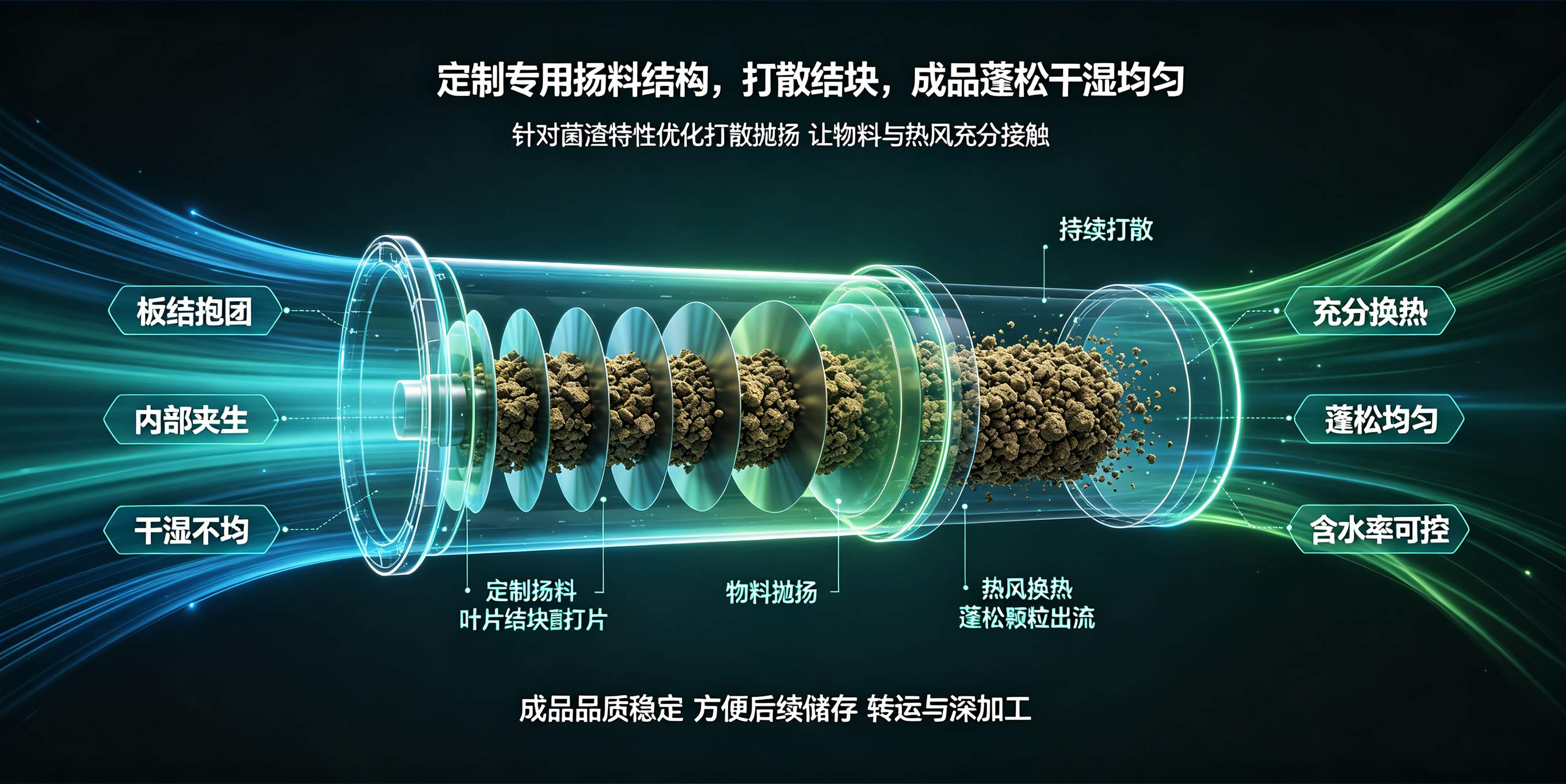
五、烘干菌渣两大变现路径,一份废料两份收益
烘干处理后的食用菌菌渣保留丰富有机质、微量元素,市场应用场景广阔,真正做到废料变盈利原料:
路径一:二次制作食用菌培养基 经过烘干灭菌处理,杂质筛分之后,可以重新回用作食用菌栽培基质,循环用于菌包生产,降低基地原材料采购成本,实现产业内部循环。
路径二:优质有机肥原料 烘干菌渣是制作生物有机肥、土壤改良基质的优质原料,养分充足,可直接外销有机肥加工厂,也可基地自建有机肥生产线,对外销售成品肥料,拓展企业第二营收渠道。
菌渣不再是要花钱处理的废弃物,而是可以产生收益的优质生物质原料。
V. Two Value‑Realization Paths for Dried Mushroom Substrate: Double Benefits from One Batch of Waste
Dried spent edible‑fungus substrate retains abundant organic matter and trace elements, boasting broad market application scenarios and turning waste into profitable raw materials.
Path 1: Reprocessing into edible‑fungus culture medium
After drying, sterilization and impurity screening, the substrate can be reused as cultivation medium for edible fungi for fungus‑bag production. It cuts raw‑material procurement costs for the base and realizes intra‑industry circular utilization.
Path 2: High‑quality raw material for organic fertilizer
Dried mushroom substrate serves as premium feedstock for bio‑organic fertilizer and soil‑conditioning medium with rich nutrients. It can be sold directly to organic‑fertilizer manufacturers, or processed into finished fertilizer via an on‑site self‑built production line to open up a second revenue stream for the enterprise.
Instead of being costly waste requiring paid disposal, spent mushroom substrate becomes high‑value biomass raw material capable of generating economic returns.
六、适配大型菌菇产业园、菌渣集中处理中心成套产线
金万泓可提供完整菌渣处理成套生产线,从菌棒破碎、上料输送、三回程烘干、除尘除臭到成品出料一体化配置。既可以服务单家大型工厂化食用菌基地,就地消化本厂产出废菌渣;也可面向区域性菌渣集中处理中心,集中回收周边多家种植基地废菌渣,统一加工处理,形成区域性固废资源化加工站点。
设备产能可按需定制,大小型号齐全,适配不同日处理吨位需求,成套交付,落地即可投产。
VI. Complete Production Lines for Large‑Scale Mushroom Industrial Parks and Centralized Spent‑Substrate Treatment Centers
Jinwanhong supplies full‑set integrated production lines for spent mushroom substrate treatment, integrating fungus stick crushing, feeding and conveying, triple‑pass drying, dust removal & deodorization, and finished‑material discharging.
The system can serve individual large‑scale industrial edible‑fungus bases to dispose of self‑generated waste substrate on‑site. It also applies to regional centralized substrate‑treatment centers, which collect waste from multiple surrounding planting bases for unified processing and build regional solid‑waste resource‑recycling stations.
Equipment capacity can be customized as required with a full range of model options for different daily‑throughput demands. Complete‑set delivery enables quick commissioning upon installation.
七、节能低碳,契合无废园区、种养循环项目建设标准
在无废农业、种养循环的政策导向之下,食用菌菌渣属于典型农业生物质固废。三回程烘干成套产线,实现菌渣减量化、无害化、资源化处置,减少废弃物填埋、随意堆放带来的污染,降低碳排放,项目建设完全契合无废园区、农业种养循环示范项目建设标准。
项目完成后,可对接农业农村相关资源化项目申报,助力园区完成环保考核与绿色产业升级。
VII. Energy‑Saving and Low‑Carbon, Compliant with Construction Standards for Waste‑Free Parks and Planting‑Breeding Circular Projects
Under the policy guidance of waste‑free agriculture and planting‑breeding circular economy, spent mushroom substrate is classified as typical agricultural biomass solid waste. The complete triple‑pass drying production line realizes the reduction, harmless treatment and resource utilization of mushroom residue. It mitigates pollution caused by waste landfilling and random stockpiling while cutting carbon emissions. The project fully meets the construction standards for waste‑free parks and demonstration projects of agricultural planting‑breeding circular economy.
Upon project completion, enterprises can apply for relevant agricultural resource‑recycling programs. It helps industrial parks fulfill environmental‑protection assessment requirements and achieve green industrial upgrading.
结语
食用菌产业,不能只盯着菌菇产出,更要把菌渣这部分“副产品” 利用起来。 与其投入高额成本清运丢弃,不如配套烘干设备就地资源化,既解决厂区环保压力,又挖掘菌渣经济价值。
如果您是食用菌基地、菌渣集中处理企业,想要了解菌渣烘干成套方案,金万泓机械可提供场地勘测、定制产线方案,源头实体工厂,助力农业固废绿色变现。
Conclusion
The edible fungus industry should focus not only on mushroom output, but also on the full utilization of mushroom residue by‑products. Instead of spending heavily on waste transportation and disposal, equipping on‑site drying facilities to realize on‑site resource utilization can effectively relieve on‑site environmental pressure and unlock the economic value of spent mushroom substrate.
If you operate an edible fungus base or a centralized mushroom residue treatment enterprise and intend to learn about complete mushroom residue drying solutions, Jinwanhong Machinery provides on‑site survey and customized production line solutions. As an original manufacturer, we help enterprises realize green and profitable recycling of agricultural solid waste.