【引言】
近几年畜禽养殖行业彻底告别暴利时代,进入低利润、高波动、高成本内卷周期。鸡苗、饲料、人工、水电成本逐年攀升,畜禽出栏价格完全随市场波动,主业利润透明且极不稳定。单一靠养殖赚钱的模式,抗风险能力极差,一旦遭遇行情低谷、疫病风险,很容易陷入保本甚至亏损困境。
行业头部养殖场早已突破单一盈利思维,不再只盯着“卖鸡赚钱”,而是盘活场内闲置资源,把人人嫌弃的粪污废料,做成全年稳定的第二现金流。依托粪污烘干资源化模式,实现降本、增收、拿补贴三重收益,彻底打破养殖增收难的行业瓶颈。
In recent years, the livestock‑breeding industry has bid farewell to the era of excessive profits and entered a cycle of low margins, high volatility and cut‑throat cost‑driven competition. Costs for chicks, feed, labour, water and electricity keep rising year by year, while livestock selling prices fluctuate fully with market conditions. Profit from core breeding operations is thin and highly unstable. A business model relying solely on breeding carries extremely poor risk resistance. Once hit by market downturns or disease outbreaks, farms can easily slip into break‑even or even loss‑making situations.
Leading farms in the industry have long moved beyond single‑source profit‑making thinking. Instead of focusing merely on revenue from selling livestock, they activate idle on‑site resources and turn unwanted manure waste into a stable secondary cash flow all‑year‑round. Supported by the manure‑drying resource‑utilization model, farms achieve triple benefits: cost reduction, revenue growth and subsidy access, breaking the long‑standing industry bottleneck of limited profit growth for breeding operations.
一、当下养殖行业现状:单一盈利模式风险极高,增收渠道稀缺
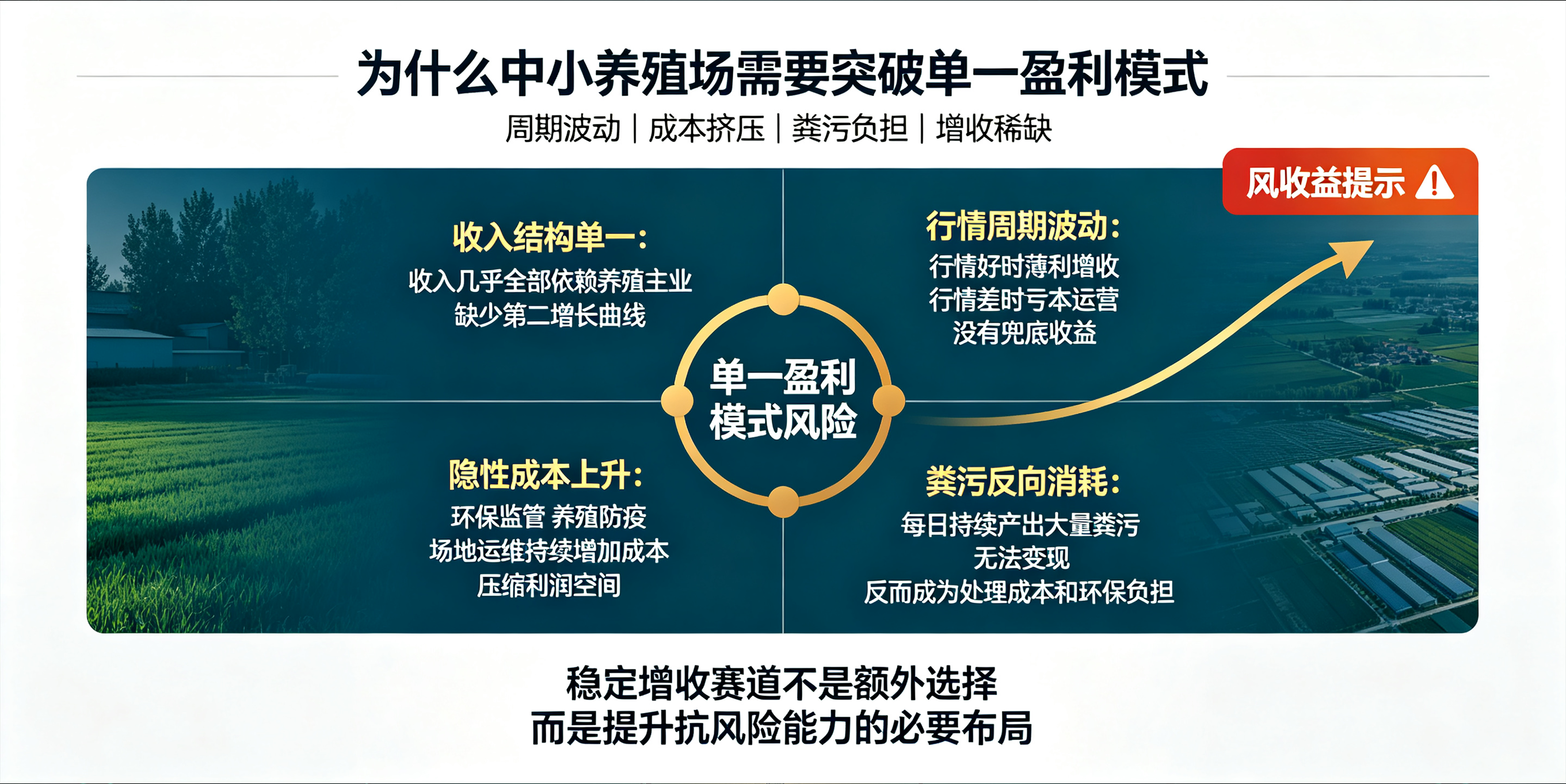
目前绝大多数中小养殖场的经营痛点高度统一:收入全靠养殖主业,成本逐年攀升,风险全盘自担。
养殖行情周期性波动明显,行情好时薄利增收,行情差时亏本运营,没有任何兜底收益;同时环保监管、养殖防疫、场地运维持续增加隐性成本,挤压原本微薄的利润空间。
更关键的是,传统养殖场没有任何副业增收渠道,场内每天持续产出的大量粪污,不仅无法变现,反而成为持续消耗成本的负担。在行业内卷加剧的当下,多一条稳定增收赛道,就多一份抗风险底气。
I. Current Status of the Breeding Industry: High Risks for Single‑source Profit Models and Scarce Additional Revenue Streams
Most small‑and‑medium‑sized farms share identical operational pain points: all revenue comes from core breeding activities, costs climb annually, and all risks are borne by the business itself.
Breeding markets feature pronounced cyclical swings. Modest gains appear in boom periods, while losses occur in downturns with no fallback income. Meanwhile, environmental supervision, epidemic prevention and site maintenance drive up hidden costs and squeeze already narrow profit margins.
More critically, traditional farms have no side‑business revenue channels. Large volumes of manure generated daily cannot be monetized; on the contrary, they become a continuous financial burden. As industry competition intensifies, one more stable profit stream brings greater risk resilience.
二、传统粪污处理:纯消耗、无收益,年年白白亏钱
在未做资源化改造前,粪污是所有养殖场的“固定亏损项”,每年都要投入大量资金、人力处理,只有支出、没有回报:
✅ 清运成本:常年付费找第三方清运,旺季运费涨价,年度清运费用少则数万、多则十几万;
✅ 整改成本:粪污堆积发霉、异味扰民、蚊虫滋生,频繁遭遇投诉整改,产生罚款、消杀、场地清理等额外支出;
✅ 场地成本:占用大量养殖场地堆放粪污,浪费有效生产空间,制约养殖场规模扩容;
✅ 隐性风险成本:粪污乱堆乱放不合规,随时面临停产整治、环评扣分的经营风险。
总结来说:传统模式下,粪污是纯成本负担,常年消耗养殖场利润,没有任何变现价值。
II. Conventional Manure Disposal: Pure Expense with Zero Returns, Resulting in Persistent Annual Losses
Before resource‑oriented transformation, manure represents a “fixed loss item” for every farm. Substantial capital and labour are consumed each year for disposal, bringing only outlay with no payback: ✅ Haul‑away costs: Continuous payment for third‑party removal services. Freight rates surge in peak seasons, with annual haul‑away expenses ranging from tens of thousands to over one hundred thousand RMB. ✅ Rectification costs: Accumulated manure goes mouldy, generates odour nuisances and breeds pests. Frequent complaints trigger rectification requirements, incurring extra spending on fines, disinfection and site cleaning. ✅ Site‑occupation costs: Manure stockpiling occupies substantial farm land, wasting productive space and restraining capacity expansion. ✅ Hidden compliance risks: Improper manure storage exposes operations to production‑halt rectification and negative EIA assessment outcomes.
In short: under the traditional model, manure acts purely as a cost burden that erodes farm profits without any monetization value.
三、自营降本增收:粪污变有机肥,省下的就是纯利润
多数规模化养殖场都配套种植基地、果园、苗木、农作物种养板块,以往需要常年外购商品有机肥、化肥,采购成本居高不下,且长期施用化肥易造成土壤板结、地力下降。
搭载金万泓卧式闪蒸烘干设备后,鲜鸡粪经高温瞬时灭菌、脱水烘干处理,彻底杀灭病菌虫卵,保留完整有机质与氮磷钾养分,成为纯天然优质有机肥原料。
养殖场实现粪污自产自用,完全替代外购化肥、有机肥,大幅降低种植端采购成本,改良土壤、提升果蔬作物品质与产量。无需额外投入,仅靠省下来的采购费,每年就能省下数万至十几万纯收益,降本就是最稳妥的增收。
III. In‑house Cost‑saving & Revenue Boost: Manure Converted into Organic Fertilizer; Saved Expenses Equal Net Profit
Many large‑scale farms operate supporting planting segments such as orchards, seedling nurseries and crop fields. Traditionally, commercial organic fertilizer and chemical fertilizer must be purchased at high cost. Long‑term chemical fertilizer application also causes soil compaction and declining soil fertility.
Equipped with Jinwanhong horizontal flash drying equipment, fresh chicken manure undergoes high‑temperature instant sterilization and dehydration drying. Pathogens and parasite eggs are fully eliminated while organic matter and N‑P‑K nutrients are preserved, producing high‑quality raw material for natural organic fertilizer.
Farms achieve self‑sufficient manure recycling, substantially cutting procurement spending on chemical and organic fertilizers, improving soil quality and lifting the quality and yield of fruits, vegetables and crops. With no extra investment required, saved procurement expenditure generates net annual gains ranging from tens of thousands to over one hundred thousand RMB. Cost reduction is the most reliable form of profit growth.
四、代工被动增收:承接周边粪污代加工,赚取稳定服务费
这是目前回报率最高、最省心的副业盈利模式,尤其适合中大型规模化养殖场。
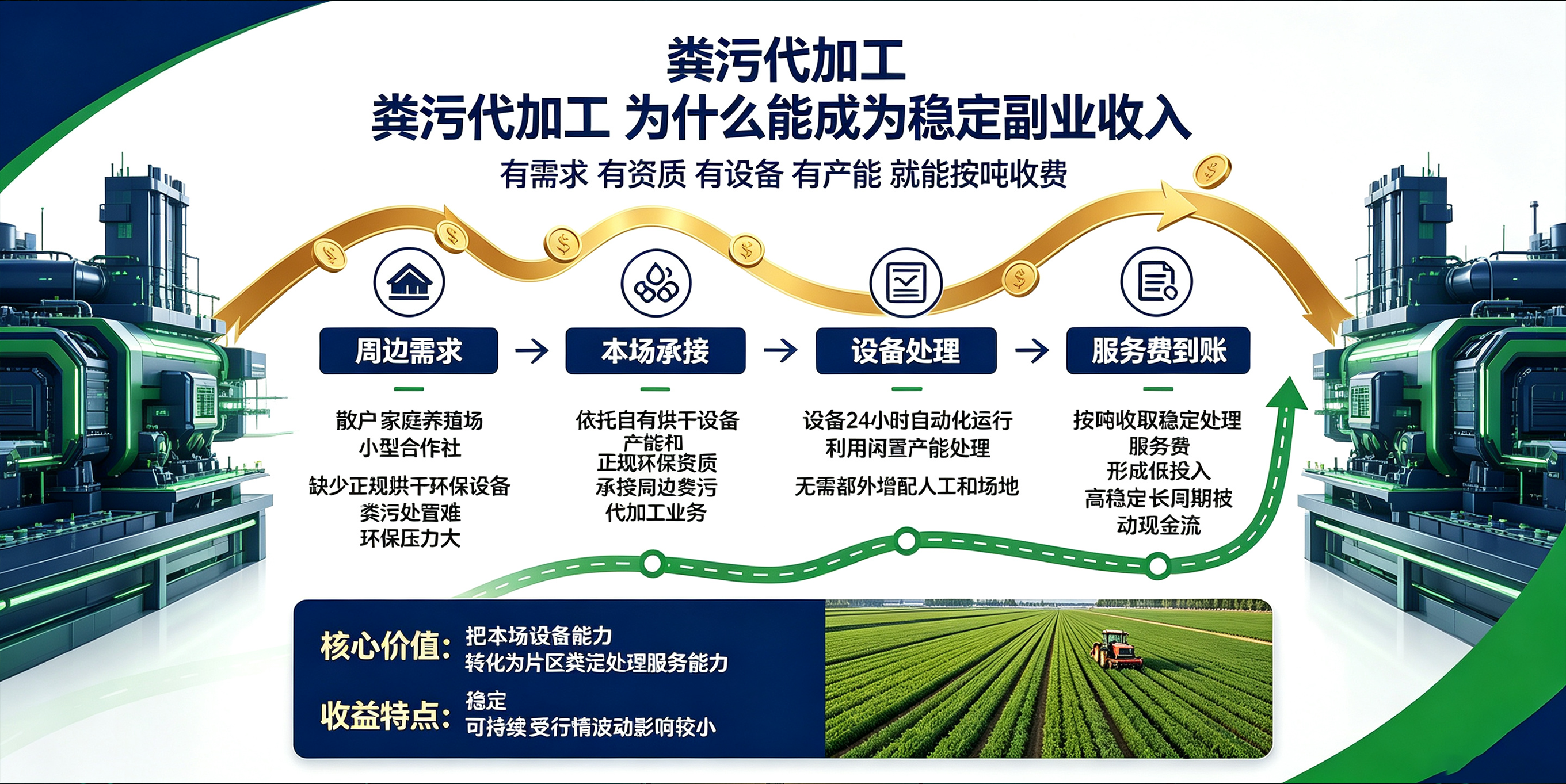
养殖片区内大量小型散户、家庭养殖场、小型合作社,受资金、场地、资质限制,无法配套正规烘干环保设备,粪污无合规处置渠道,常年面临环保投诉、整改压力,急需专业机构代为处理。
本场完成烘干设备布局后,可依托自有设备产能、正规环保资质,承接周边散户、小型养殖场粪污代加工业务,按吨收取稳定处理服务费。
设备24小时自动化运行,闲置产能零成本变现,无需额外增配人工、场地,仅利用设备空余产能即可持续创收,属于低投入、高稳定、长周期的被动现金流。
IV. Passive Income via Contract Processing: Generate Stable Service Fees from Third‑party Manure Treatment
This side‑business model delivers among the highest returns with minimal management effort, especially suited for medium‑to‑large‑scale farms.
Within breeding zones, numerous small independent farmers, family farms and small cooperatives lack capital, land and qualifications to install compliant drying and environmental‑protection facilities. Without legal disposal channels, they face constant risks of environmental complaints and mandatory rectification and are in urgent need of professional third‑party treatment services.
After installing drying equipment, farms can leverage their processing capacity and formal environmental permits to undertake contract manure‑treatment services for neighbouring small‑scale operators and charge stable per‑ton processing fees.
The equipment runs automatically 24 hours a day. Idle capacity is monetized at almost no additional cost, requiring neither extra labour nor extra land. It delivers low‑input, stable and long‑term passive cash flow.
五、产品外销增收:标准化干粪成品,四季稳定变现回款
烘干处理后的干鸡粪,含水率标准、蓬松干爽、无菌无异味、有机质含量高,是有机肥厂、果蔬种植基地、园林工程、苗木培育的刚需原料,市场需求常年供不应求,销路稳定无淡季。
相较于湿粪低价甩卖、无人问津的窘境,标准化干粪成品溢价空间充足,干湿物料差价即为纯利润。养殖场可长期定点对接有机肥加工厂、大型种植园区、农资经销商,批量外销、稳定回款,把每日废弃粪污,变成常年可持续的商品营收。
从“花钱处理废料”到“卖废料赚钱”,彻底逆转粪污的资产属性。
V. Additional Revenue from Product Sales: Standardized Dried Manure for Steady Year‑round Monetization
Dried chicken manure features controlled moisture content, fluffy texture, sterility and low odour with high organic‑matter content. It constitutes high‑demand feedstock for organic‑fertilizer plants, fruit‑vegetable planting bases, landscape‑engineering projects and seedling cultivation. Market demand consistently outstrips supply with no off‑season slump.
In contrast to low‑value, hard‑to‑sell wet manure, standardized dried‑manure finished goods command considerable price premiums. The price gap between wet and dry material translates directly into net profit. Farms may establish long‑term partnerships with organic‑fertilizer manufacturers, large‑scale planting parks and agricultural‑input distributors for bulk sales and steady cash collection. Daily waste manure is turned into sustainable commercial revenue.
The asset nature of manure is completely reversed: from “spending money to dispose of waste” to “earning money by selling processed waste”.
六、精准投入产出核算:不同规模鸡场回本周期、年度增收明细
结合2026年行业市场价、设备能耗、人工运维、补贴政策,为大中小三类养殖场做真实落地收益测算,数据贴合一线实景:
1. 小型鸡场(80-100万羽)
运营模式:自用降本+少量外销,无代工业务
年度收益:节省清运、整改、施肥成本、外销增收,综合年增收30%
回本周期:8-12个月,回本快、风险低,适配小型养殖场稳妥创收需求
2. 中型鸡场(100-200万羽)
运营模式:自用降本+批量外销+周边少量代工
年度收益:综合降本+产品外销+代工服务费,年纯增收15-25万元
回本周期:6-8个月,收益稳定,快速盘活设备产能
3. 大型养殖产业园(300万羽以上)
运营模式:规模化外销+区域集中代工+项目政策补贴
年度收益:多元营收叠加,年纯增收30-80万元,叠加政策补贴回本更快
回本周期:4-6个月,形成标准化循环盈利体系,长期收益可观
核心总结:烘干设备不是消费投入,是养殖场的经营性固定资产,一次性投入,长期降本、常年增收。
VI. Precise Input‑output Calculation: Payback Period and Annual Revenue Breakdown for Chicken Farms of Different Scales
Based on 2026 market prices, equipment energy consumption, labour and maintenance costs and subsidy policies, practical profit projections are provided for small‑, medium‑ and large‑scale farms reflecting real‑world operating conditions:
Small‑scale chicken farm (800 000‑1 000 000 birds) Operating mode: in‑house cost reduction plus limited external sales; no contract‑processing services Annual benefit: combined gains from saved haul‑away, rectification and fertilization costs plus product sales deliver roughly 30% comprehensive annual profit increase. Payback period: 8‑12 months. Fast payback with low risk, matching conservative profit‑growth needs for small‑scale operations.
Medium‑scale chicken farm (1 000 000‑2 000 000 birds) Operating mode: in‑house cost reduction plus bulk product sales plus moderate third‑party contract processing for neighbouring clients Annual net profit increase: RMB 150 000‑250 000 from combined cost savings, product sales and processing service fees. Payback period: 6‑8 months. Stable returns and rapid activation of equipment capacity.
Large‑scale breeding industrial park (over 3 000 000 birds) Operating mode: large‑volume product sales plus regional centralized contract processing plus policy‑project subsidies Annual net profit increase: RMB 300 000‑800 000 from multiple revenue streams. Subsidies further shorten payback time. Payback period: 4‑6 months. A standardized circular profit‑making system delivers substantial long‑term returns.
Core conclusion: drying equipment is not a consumable expense but an operating fixed asset for farms. A one‑time investment brings sustained cost savings and year‑round extra revenue.
七、贴合绿色农业政策,合规增收双重红利,可申领专项补贴
2026年国家持续大力推进循环农业、无废养殖、种养循环、绿色农业发展,畜禽粪污资源化利用是重点扶持赛道,政策红利持续释放。
布局粪污烘干资源化项目,不仅能实现自主增收,还可合规享受多重政策红利:
✅ 畜禽粪污资源化设备改造专项补贴(最高补贴总投资50%);
✅ 无废农场、种养循环示范项目专项奖补;
✅ 固废综合利用增值税、企业所得税减免政策;
✅ 绿色养殖、低碳农业项目扶持资金。
既符合环保合规硬性要求,又能依托政策降低设备投入成本,实现合规无忧、副业增收、政策兜底的三重经营优势,完美适配未来养殖行业发展趋势。
VII. Aligned with Green‑agriculture Policies: Dual Dividends of Compliance and Profit plus Special‑subsidy Eligibility
In 2026, the State continues to strongly promote circular agriculture, zero‑waste breeding, planting‑breeding circular systems and green agricultural development. Livestock‑manure resource utilization ranks among key‑support sectors with ongoing policy incentives.
Investing in manure‑drying resource‑utilization projects not only generates independent extra revenue but also unlocks multiple policy benefits under full compliance: ✅ Special subsidies for livestock‑manure resource‑utilization equipment retrofitting (up to 50 % of total investment); ✅ Special rewards for zero‑waste farms and planting‑breeding circular demonstration projects; ✅ VAT and corporate‑income‑tax relief for comprehensive solid‑waste utilization; ✅ Grant funding for green‑breeding and low‑carbon‑agriculture initiatives.
Farms satisfy mandatory environmental‑compliance requirements while lowering equipment investment via policy support. Three‑fold operational advantages are achieved: regulatory compliance, side‑business profit growth and policy backing, perfectly matching future development trends within the breeding sector.
写在最后
未来养殖行业的核心竞争力,不再是单纯比拼养殖规模,而是比拼资源利用率与综合盈利能力。
单一养殖主业利润微薄、风险难控,而粪污资源化烘干模式,让养殖场彻底告别粪污纯消耗困境,通过自用降本、代工创收、产品外销三大路径,打造稳定副业现金流,把每一份废弃粪污都转化为实实在在的收益。
在行业内卷加剧的当下,提前布局粪污资源化,就是提前锁定长效盈利赛道,让养殖场实现主业稳营收、副业稳增收的双保险经营模式。
想要根据你的养殖规模,精准测算年度增收金额、定制专属盈利方案,免费勘测场地,欢迎咨询金万泓机械。
Closing Remarks
Future core competitiveness in the breeding industry will no longer depend purely on production scale but rather on resource‑utilization efficiency and comprehensive profitability.
Profit margins from standalone breeding operations remain thin and hard‑to‑control. The manure‑drying resource‑utilization model frees farms from the burden of purely loss‑generating manure disposal. Through three channels — in‑house cost reduction, contract‑processing revenue and finished‑product sales — stable side‑business cash flow is built, converting every tonne of waste manure into tangible gains.
Amid intensifying industry competition, early deployment of manure resource‑utilization secures a long‑term profit track, enabling a dual‑safety‑net business model: steady revenue from core breeding plus consistent extra income from side operations.
If you would like precise annual‑revenue estimation and a customized profit‑making solution tailored to your farm scale together with free site survey service, please contact Jinwanhong Machinery.