【引言】
竹木加工产业生产过程中,会产生大量鲜竹片物料。刚经过采伐、裁切的竹片原生含水率居高不下,物料本身含糖含水高,储存处置一直是困扰竹木加工厂的一大难题。
鲜竹片如果得不到及时干燥处理,不仅仓储、运输成本成倍上涨,还容易发霉变质,直接丧失加工价值。想要把竹片用于板材、生物质燃料等工业化深加工,稳定可控的烘干工序,是必不可少的关键环节。
传统晾晒模式已经很难适配现代化工厂规模化生产需求,金万泓单筒烘干机针对竹片片状物料特性定向优化,高效完成湿竹片干燥提质,助力竹木固废资源化变现。
Large‑quantities of fresh bamboo chips are generated during bamboo‑wood processing. Freshly harvested and cut bamboo chips feature inherently high moisture and sugar content, and their storage and disposal have long posed a major headache for bamboo‑wood processing plants.
Without timely drying, fresh bamboo chips bring not only multiplied warehousing and transportation costs, but also high risks of mildew and deterioration, which render them completely unfit for further processing. For deep‑industrial applications such as board production and biomass fuel manufacturing, a stable and controllable drying procedure is an indispensable core step.
Traditional open‑air sun‑drying can hardly meet the large‑scale production demands of modern factories. The Jinwanhong single‑cylinder dryer is specially optimized for flaky bamboo‑wood materials. It efficiently dries and improves the quality of wet bamboo chips and helps convert bamboo‑wood solid waste into revenue‑generating resources.
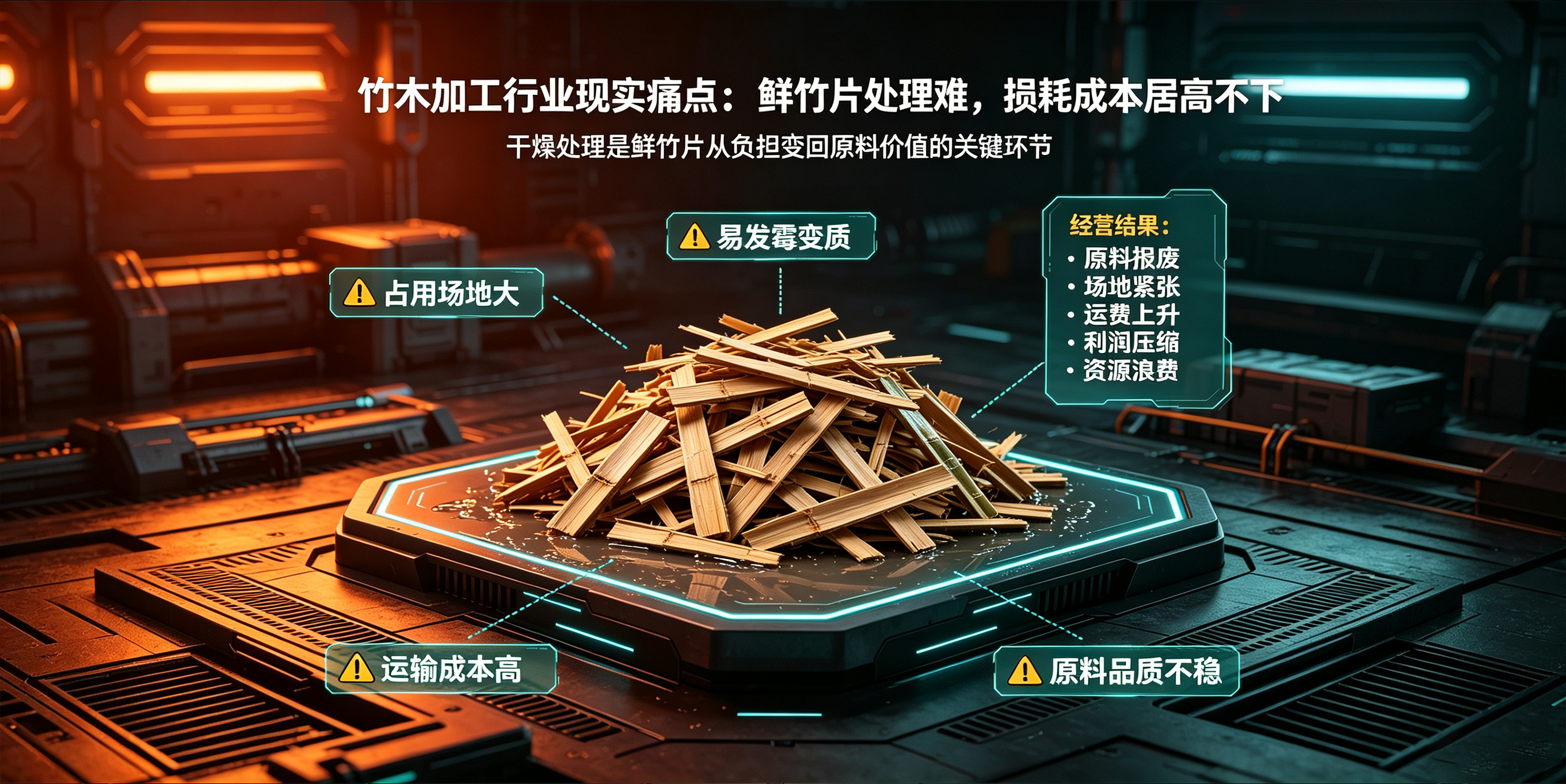
一、竹木加工行业现实痛点:鲜竹片处理难,损耗成本居高不下
竹材采伐与深加工企业,每天产出大量湿竹片边角料,普遍面临几大棘手问题:
✅ 含水率高不易存储:新鲜竹片水分含量高,堆积存放内部极易发热,短时间就出现发霉、腐烂、发黑变质,物料直接报废;
✅ 堆放占用场地大:大量竹片露天堆存,需要占用大片厂区场地,物料堆放杂乱,厂区管理压力大;
✅ 运输成本高昂高水分带来物料自重增加,外运运输成本大幅提升,很多时候运费已经超过物料本身价值;
✅ 原料品质不稳定:霉变、腐坏的竹片无法用于板材、生物质颗粒生产,直接造成原料损耗,压缩企业利润空间。
不少加工厂手握大量竹片原料,却因为干燥难题,只能低价处理甚至直接废弃,白白浪费宝贵的竹木资源。
I. Real‑world Pain Points in the Bamboo‑wood Processing Industry: Difficult Fresh‑chip Handling and High Material‑loss Costs
Enterprises engaged in bamboo harvesting and deep processing produce massive volumes of wet bamboo‑chip scraps every day and commonly face several tough challenges: ✅ Poor storability due to high moisture: Fresh bamboo chips contain abundant water. Piled stockpiles easily generate internal heat, leading to mildew, rot and black discoloration within a short time, and total material scrapping. ✅ Heavy site occupation: Large‑volume outdoor chip stockpiles occupy extensive factory premises, creating messy stacking conditions and raising site‑management burdens. ✅ Exorbitant transport expenses: High moisture increases material dead weight and sharply pushes up outbound shipping costs. Freight charges often exceed the intrinsic value of the chips themselves. ✅ Unstable raw‑material quality: Mildewed and rotten bamboo chips cannot be used for board or biomass‑pellet production, causing direct raw‑material losses and squeezing corporate profit margins.
Many processing plants possess abundant bamboo‑chip feedstock yet are forced to sell materials at low prices or discard them outright due to drying bottlenecks, wasting valuable bamboo‑wood resources.
二、传统处理方式短板重重,难以满足工业化生产标准
很多竹木加工厂依旧依靠露天晾晒处理竹片,这种原始处理模式弊端十分突出:
❌ 高度受制于天气条件,阴雨天、梅雨季完全无法作业,生产节奏完全看天气;
❌ 晾晒周期漫长,需要大面积晒场,场地资源有限,处理规模上不去,不适合大批量连续生产;
❌ 物料品质不可控,晾晒过程竹片容易沾染泥沙杂质,局部受潮霉变发黑,成品品质参差不齐;
❌ 无法稳定达标,人工晾晒含水率波动大,很难达到生物质颗粒、人造板材的原料含水率硬性指标,后续深加工容易出现成品缺陷。
想要实现竹片资源化利用,就需要一套工业化烘干设备,摆脱天气约束,稳定输出合格干料。
II. Severe Drawbacks of Conventional Handling Methods, Incompatible with Industrial Production Standards
Numerous bamboo‑wood processors still rely on open‑air sun‑drying for bamboo chips, a primitive approach with prominent disadvantages: ❌ Heavily weather‑dependent: Operations halt entirely during rainy weather and plum‑rain seasons; production schedules are fully subject to meteorological conditions. ❌ Long drying cycles and large‑area yard requirements: Limited yard space restricts throughput and prevents large‑volume continuous production. ❌ Uncontrollable material quality: Chips readily pick up sand and dirt during sun‑drying; partial dampness causes mildew and blackening, resulting in inconsistent finished‑product quality. ❌ Difficulty in meeting stable specifications: Wide moisture fluctuations from manual sun‑drying make it hard to hit mandatory moisture thresholds for biomass pellets and wood‑based panels, triggering finished‑product defects in subsequent deep processing.
To realise resource‑based utilisation of bamboo chips, industrial drying equipment is required to break weather‑related restraints and steadily deliver qualified dry material.
三、金万泓单筒烘干机,顺流工艺适配湿竹片大批量干燥
针对竹片这种片状竹木物料,金万泓单筒烘干机采用成熟顺流烘干工艺,高温热风直接与湿竹片充分接触换热,热交换充分,整机处理量大,烘干效率突出。
顺流工艺下高温热风跟随物料同步向前输送,进料端高温度快速带走竹片表面大量水分,随着物料逐步向前移动,温度平缓下降,避免局部温度过高造成竹片焦糊、碳化,很好保护竹片本身材质。
设备可适配高含水率鲜竹片直接入料,不需要复杂预处理,整机运行负荷稳定,能够匹配竹木加工厂连续化产出节奏。
III. Jinwanhong Single‑cylinder Dryer: Co‑current Process for Large‑volume Wet‑bamboo‑chip Drying
For flaky bamboo‑wood feedstock such as bamboo chips, the Jinwanhong single‑cylinder dryer adopts a proven co‑current drying process. High‑temperature hot air makes full direct contact with wet bamboo chips for sufficient heat exchange, delivering high overall throughput and outstanding drying efficiency.
Under the co‑current principle, high‑temperature hot‑air flows forward together with the material. High inlet‑section temperatures rapidly remove large amounts of surface moisture from bamboo chips. As materials advance gradually, temperatures decline gently, avoiding scorching and carbonisation caused by local over‑heating and preserving the native properties of bamboo chips.
The unit accepts high‑moisture fresh bamboo chips for direct feeding without complex pre‑treatment. Stable operating loads match the continuous output rhythm of bamboo‑wood processing plants.
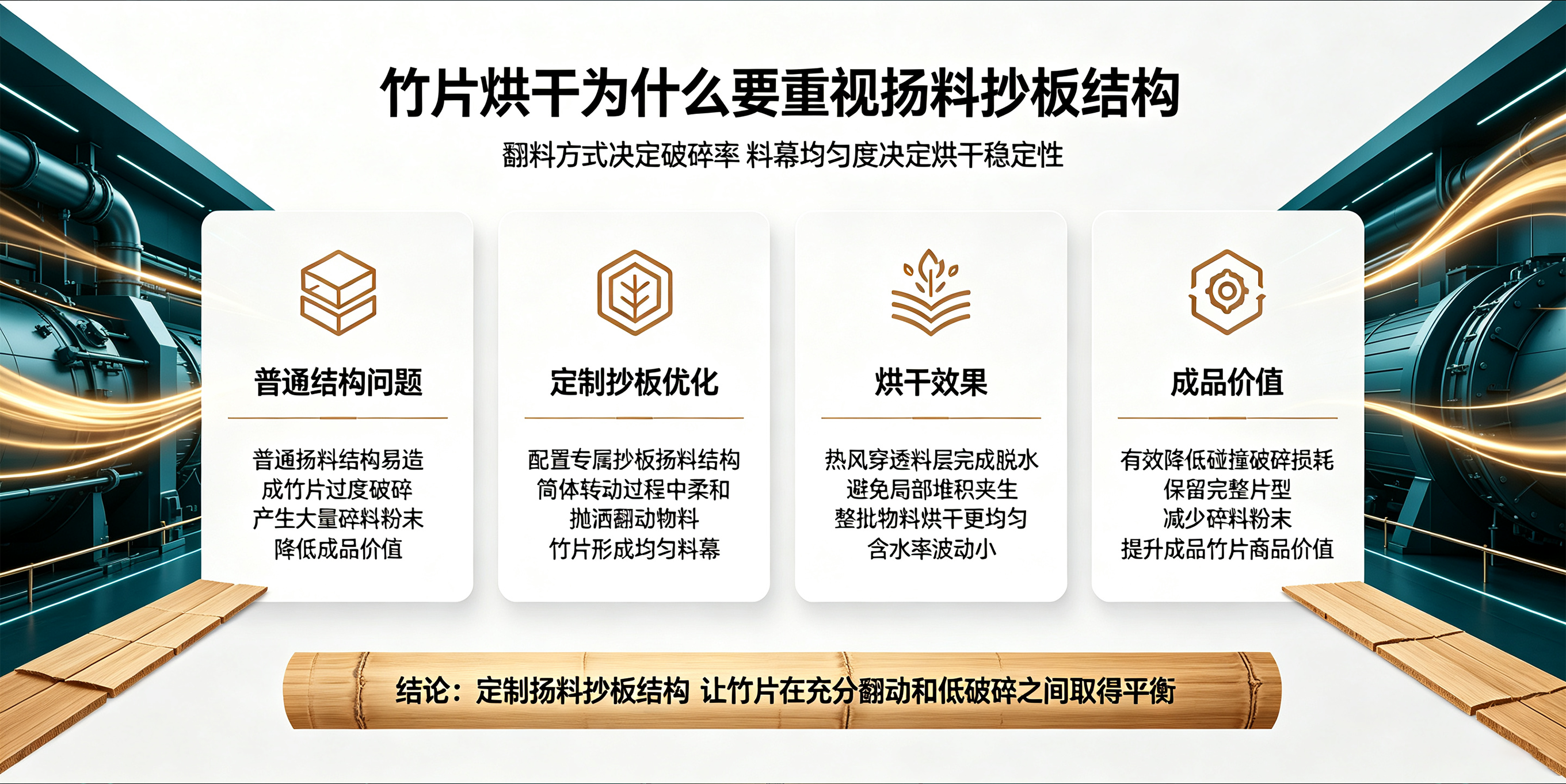
四、定制扬料抄板结构,减少破碎,保障烘干均匀度
片状竹片质地脆,普通烘干设备内部扬料结构容易造成竹片过度破碎,产生大量碎料粉末,降低成品价值。
金万泓针对竹片物料做结构优化,配置专属抄板扬料结构,筒体转动过程中柔和抛洒翻动物料,竹片形成均匀料幕,热风穿透料层完成脱水。
既实现物料充分翻动,避免局部物料堆积夹生,保障整批物料烘干均匀,含水率波动小;同时有效降低竹片碰撞破碎损耗,保留完整片型,保障成品竹片的商品价值。
IV. Custom Lifting‑flight Structure: Reduced Breakage and Uniform Drying
Bamboo chips are brittle. Generic dryer lifting internals tend to over‑fragment chips, generating excessive fine debris and powder and lowering finished‑product value.
Jinwanhong carries out targeted structural optimisation for bamboo chips by installing dedicated lifting flights. As the cylinder rotates, materials are tossed and turned gently to form an even material curtain through which hot‑air penetrates to complete dewatering.
Sufficient material turnover prevents local accumulation and under‑drying, ensuring batch‑wide drying uniformity with minimal moisture variation. Meanwhile, collision‑induced chip breakage is effectively mitigated, preserving intact chip shapes and safeguarding the commercial value of finished bamboo chips.
五、烘干完成竹片,多条路径实现增值变现
经过单筒烘干机处理之后,含水率达标的干竹片,应用场景十分广泛,真正做到一物多用:
生物质颗粒燃料原料:干燥竹片是优质生物质原料,用来压制生物质颗粒,作为清洁能源燃料对外销售;
人造板材原料:合格干竹片可供给板材企业,用于竹板材、复合板材生产加工;
竹炭加工原料:干燥后竹片更适合炭化工艺,产出竹炭系列产品;
食用菌栽培基质:处理合格竹片经过粉碎,用作食用菌种植培养基原料。
原本棘手的加工边角废料,经过烘干提质之后,变身多渠道变现的优质原料,拓宽企业盈利渠道。
V. Value‑added Diversified Applications for Dried Bamboo Chips
Properly dried bamboo chips with target‑range moisture content support a wide spectrum of applications and achieve multi‑purpose utilisation:
Biomass‑pellet feedstock: Dry bamboo chips serve as premium biomass raw material for pressing biomass pellets sold as clean‑energy fuel.
Wood‑based‑panel feedstock: Qualified dry chips are supplied to panel manufacturers for bamboo‑board and composite‑board production.
Bamboo‑charcoal feedstock: Dried chips are well‑suited for carbonisation to produce bamboo‑charcoal series goods.
Edible‑fungi growing substrate: Processed qualified chips are crushed and utilised as culture medium for edible‑mushroom cultivation.
Formerly troublesome processing scraps are upgraded by drying into high‑value multi‑market feedstock, expanding corporate revenue streams.
六、多场景成套产线适配,适配不同规模生产需求
金万泓单筒竹片烘干设备,既可做单机独立使用,也可以搭配上料、破碎、除尘、冷却、筛分等单元,搭建完整成套烘干生产线。
广泛适配中小型竹木加工厂、大型竹材产业园、生物质燃料加工厂,兼顾中小产能以及大规模集中处理项目,根据厂区实际场地、物料处理量,定制整套落地解决方案。
VI. Complete Production‑line Configurations for Multiple Scenarios, Matching Diverse‑scale Production Requirements
The Jinwanhong single‑cylinder bamboo‑chip dryer can run as a standalone unit or be combined with feeding, crushing, dust‑removal, cooling and screening modules to construct full drying production lines.
It is widely deployed for small‑to‑medium bamboo‑wood mills, large‑scale bamboo industrial parks and biomass‑fuel processing plants, covering both modest‑capacity and large‑centralised‑processing projects. Customised turn‑key solutions are formulated according to actual site conditions and material‑processing volumes.
七、运行稳定运维简便,契合固废综合利用项目建设标准
整套单筒烘干设备结构成熟可靠,整机故障率低,日常运维简单,操作人员上手门槛不高,降低工厂人工管理压力。
设备配套除尘环保系统,控制粉尘外溢,满足厂区环保管控要求。项目建设契合竹木固废综合利用、生物质能源发展相关建设方向,可对接相关资源化项目申报条件。
VII. Stable Operation & Simple Maintenance, Compliant with Solid‑waste Comprehensive‑utilisation Project Standards
The single‑cylinder dryer features mature, reliable construction, low failure rates and straightforward routine maintenance. Operators can master workflows easily, easing factory labour‑management burdens.
Matching dust‑control environmental‑protection systems limit dust emissions and satisfy plant environmental‑governance requirements. Project construction aligns with development priorities for bamboo‑wood solid‑waste comprehensive utilisation and biomass energy, meeting application eligibility for relevant resource‑recycling projects.
写在最后
竹木加工行业,原料损耗就是利润损耗。解决湿竹片烘干难题,就等于把边角废料重新变成企业的优质资产。
金万泓单筒烘干机瞄准片状竹木物料痛点,大处理量、低破碎损耗,稳定输出合格干竹片,助力竹木加工厂实现固废资源化,挖掘竹片物料的更大经济价值。
有竹片烘干项目规划,欢迎咨询金万泓机械获取定制化方案。
Within the bamboo‑wood processing sector, raw‑material losses translate directly into profit losses. Solving wet‑bamboo‑chip drying challenges turns processing scraps back into valuable corporate assets.
Targeting pain points of flaky bamboo‑wood materials, the Jinwanhong single‑cylinder dryer delivers high throughput with low breakage losses and consistently outputs qualified dry bamboo chips. It empowers bamboo‑wood processors to realise solid‑waste resource recovery and unlock greater economic value from bamboo‑chip feedstock.
If you are planning a bamboo‑chip drying project, please contact Jinwanhong Machinery for custom‑tailored solutions.